MCQ
Which of the following time measuring devices is most precise?
  • A
    A wall clock.
  • B
    A stop watch.
  • C
    A digital watch.
  • D
    An atomic clock. Give reason for your answer.

Answer

  1. An atomic clock.

Explanation:

The least count of a wall clock, stop watch, digital watch and atomic clock are 1 sec, $\frac{1}{10}\text{sec},\frac{1}{100}\text{sec and}\ \frac{1}{10^{13}}\text{sec}$ respectively. So atomic clock is most precise.

Need a full question paper?

Generate a complete, print-ready paper with questions like this in minutes — across 16+ boards, with answer keys.

Start Generating Free

Similar questions

The frequencies of two sound sources are $256 Hz$ and $260 Hz$. At $t = 0,$ the intensity of sound is maximum. Then the phase difference at the time $t = \frac{1}{16}\, sec$ will be
A body thrown vertically upwards with an initial velocity $u$ reaches maximum height in $6$ seconds. The ratio of the distances travelled by the body in the first second and the seventh second is
A mass $1\, kg$ is suspended by a thread. It is

$(i)\,$ lifted up with an acceleration $4.9\,m/{s^2}$

$(ii) \,$lowered with an acceleration $4.9\,m/{s^2}$.

The ratio of the tensions is
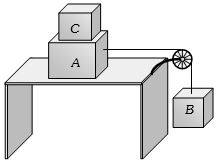
Two masses $A$ and $B$ of $10\, kg$ and $5 \,kg$ respectively are connected with a string passing over a frictionless pulley fixed at the corner of a table as shown. The coefficient of static friction of $A$ with table is $0.2$. The minimum mass of $C$ that may be placed on $A$ to prevent it from moving is ........ $kg$
The equation of a projectile is $y=\sqrt{3} x-\frac{ x^2}{2}$, the velocity of projection is
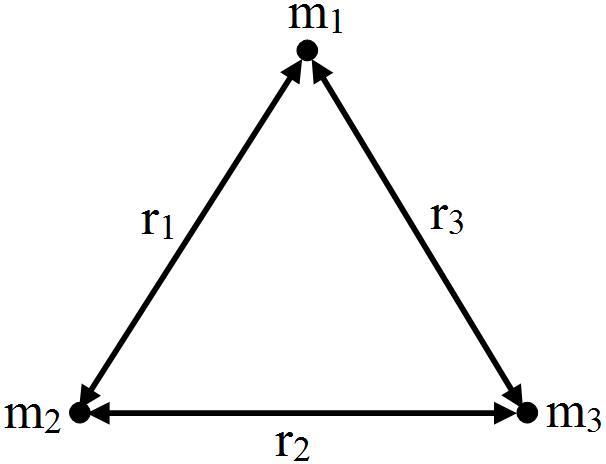
Gravitational potential energy of a system of particles as shown in the figure is:

Match List $I$ with List $II$ and select the correct answer using the codes given below the lists :

List $I$ List $II$
$P.$ Boltzmann constant $1.$ $\left[ ML ^2 T ^{-1}\right]$
$Q.$ Coefficient of viscosity $2.$ $\left[ ML ^{-1} T ^{-1}\right]$
$R.$ Planck constant $3.$ $\left[ MLT ^{-3} K ^{-1}\right]$
$S.$ Thermal conductivity $4.$ $\left[ ML ^2 T ^{-2} K ^{-1}\right]$

Codes: $ \quad \quad P \quad Q \quad R \quad S $ 
Which of the following option correctly describes the variation of the speed $v$  and acceleration $'a'$  of a point mass falling vertically in a viscous medium that applies a force $F = -kv,$ where $'k'$  is a constant, on the body? (Graphs are schematic and not drawn to scale)
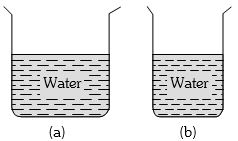
From the adjacent figure, the correct observation is
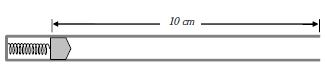
A toy gun fires a plastic pellet with a mass of $0.5\  g$. The pellet is propelled by a spring with a spring constant of $1.25\  N/cm$, which is compressed $2.0\  cm$ before firing. The plastic pellet travels horizontally $10\  cm$ down the barrel (from its compressed position) with a constant friction force of $0.0475\  N$. What is the speed (in $SI\  units$) of the bullet as it emerges from the barrel?