Question
Which of the following waves are not electromagnetic?

Answer

(b)Sound waves

Need a full question paper?

Generate a complete, print-ready paper with questions like this in minutes — across 16+ boards, with answer keys.
Start Generating Free

Similar questions

Two identical batteries, each of $e.m.f. 2$ volt and internal resistance $1.0$ ohm are available to produce heat in an external resistance $R=0.5$ ohm by passing a current through it. The maximum Joulean power that can be developed across $R$ using these batteries is
Refer to figure. Let $\Delta\text{U}_1$ and $\Delta\text{U}_2$ be the changes in internal energy of the system in the processes A and B. Then,
  1. $\Delta\text{U}_1>\Delta\text{U}_2$
  2. $\Delta\text{U}_1=\Delta\text{U}_2$
  3. $\Delta\text{U}_1<\Delta\text{U}_2$
  4. $\Delta\text{U}_1\neq\Delta\text{U}_2$
During a nuclear fusion reaction:
Electrostatic is the branch of physics which deals with the:
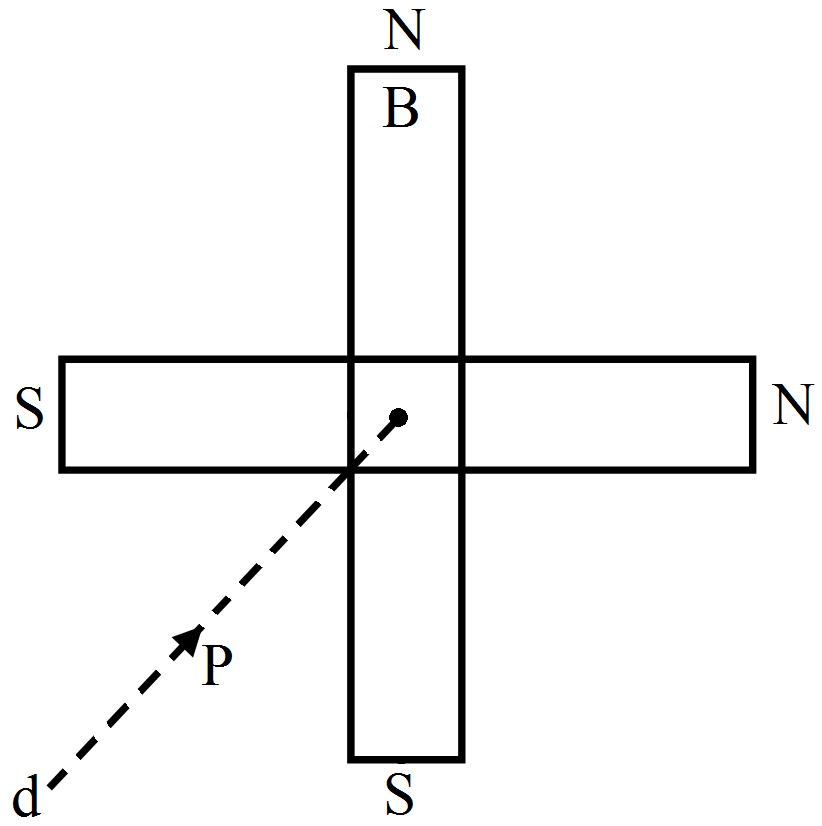
Two short magnets of equal dipole moments $M$ are fastened perpendicularly at their centre $($figure$)$. The magnitude of the magnetic field at a distance d from the centre on the bisector of the right angle is:
A coil of wire of a certain radius has $600$ turns and a self inductance of $108\ mH$. The self inductance of a $2^{nd}$ similar coil of $500$ turns will be
The muscles of a normal eye are least strained when the eye is focused on an object:
An antenna behaves as resonant circuit only when its length is
The layered lens is made of two kinds of glass. A point source of light is placed on its principal axis. If the reflections from the boundaries between layers are ignored, the lens will form
An electron and a proton are both released from rest 1 meter from a large stationary negative charge, considering only the force from the large stationary negative charge on the proton and electron. Which of the following is true?