MCQ
Which of the following will not function as a buffer solution
  • A
    $NaCl$ and $NaOH$
  • B
    $NaOH$ and $N{H_4}OH$
  • C
    $C{H_3}COON{H_4}$ and $HCl$
  • All of above

Answer

Correct option: D.
All of above
(d) Because buffer solution are mixture of weak acid or weak base and their salt.

Need a full question paper?

Generate a complete, print-ready paper with questions like this in minutes — across 16+ boards, with answer keys.

Start Generating Free

Similar questions

$CH \equiv CH\xrightarrow{{\operatorname{Re} d\,Hot\,Fe\,tube}}A\xrightarrow[{Dark}]{{C{l_2}/FeC{l_3}}}B\xrightarrow[{Anhy.\,AlC{l_3}}]{{C{H_3} - Cl}}C$ (Major)

Product $'C'$ is

In which of the following compounds, the $C-Cl$ bond ionisation shall give most stable carbonium ion?
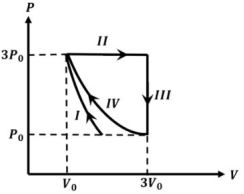
One mole of a monatomic ideal gas undergoes four thermodynamic processes as shown schematically in the $PV$-diagram below. Among these four processes, one is isobaric, one is isochoric, one is isothermal and one is adiabatic. Match the processes mentioned in List-$I$ with the corresponding statements in List-$II$.
List-$I$ List-$II$
$P$ In process $I$ $1$ Work done by the gas is zero
$Q$ In process $II$ $2$ Temperature of the gas remains unchanged
$R$ In process $III$ $3$ No heat is exchanged between the gas and its surroundings
$S$ In process $IV$ $4$ Work done by the gas is $6 P _0 V _0$

The mass of hydrogen at STP, that is present in a vessel which can hold 4 grams of oxygen under similar conditions, is:
On heating a mixture of $SO_2Cl_2$ and $CO$ two equilibria are simultaneously established 

$S{O_2}C{l_2}(g) \rightleftharpoons S{O_2}(g) + C{l_2}(g)$

$CO(g) + C{l_2}(g) \rightleftharpoons COC{l_2}(g)$

on adding more $SO_2$ at equilibrium what will happen?
The uncertainties in the velocities of two particles, $A$ and $B$ are $0.05$ and $0.02\, ms^{-1}$ respectively. The mass of $B$ is five times to that of the mass of $A$. What is the ratio of uncertainties $\frac{{\Delta {x_A}}}{{\Delta {x_B}}}$ in their positions ?
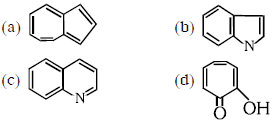
Which of the following is/are aromatic
In which of the following reaction, the hybridisation of the central atom changes from $sp^2$ to $sp^3$ ?
Based on knowledge of solid compounds and bond strengths, which of the following reactions is considered non-spontaneous due to the extremely high activation energy but once started becomes extremely spontaneous?
The densities of graphite and diamond at $298\, K$  are $2.25 $ and $3.31 \,g \,cm^{-3}$ respectively. If the standard free energy difference $(\Delta {G^o})$ is equal to $1895 \,J$ $mo{l^{ - 1}}$, the pressure at which graphite will be transformed diamond at $298\, K$  is