MCQ
Which of the following will not give iodoform test ?
  • A
    Isopropyl alcohol
  • B
    Ethanol
  • C
    Ethanal
  • Benzyl alcohol

Answer

Correct option: D.
Benzyl alcohol
d
(d)Benzyl alcohol does not have the $C{H_3}CO - $ group or $C{H_3}C{H_2}{O^ - }$so it will not give the positive iodoform test.

Need a full question paper?

Generate a complete, print-ready paper with questions like this in minutes — across 16+ boards, with answer keys.

Start Generating Free

Similar questions

Two thin lenses, when in contact, produce a combination of power $+ 10\, D$. When they are $0.25\, m$ apart, the power reduces to $+ 6D$. The focal lengths of the lenses (in $m$) are
Assuming that the dimmest visible star to the naked eye has a magnitude of about $6$ . Brightness of planet Venus (magnitude = $-4$ ) w.r.t. this star is........ times brighter
If $I = 50\, kg-m^2$, then ......... $N-m$ torque will be applied to stop it in $10\, sec$. Its initial angular speed is $20\, rad/sec$.
Statement $-1$ : Capacitor can be used in $a.c.$ circuit in place of choke coil.
Statement $-2$ : Capacitor blocks $d.c.$ and allows $a.c.$ only.
In an hour-glass approximately $100$ grains of sand fall per second (starting from rest); and it takes $2 \, s$ for each sand particle to reach the bottom of the hour-glass. If the average mass of each sand particle is $0.2 \,g$, then the average force exerted by the falling sand on the bottom of the hour-glass is close to .......... $N$
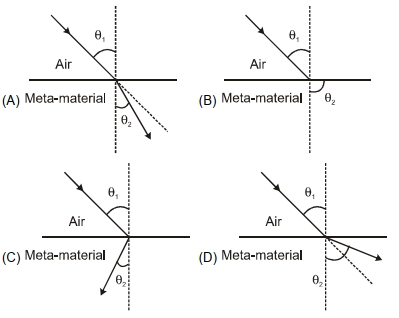
Most materials have therefractive index, $n > 1$. So, when a light ray from air enters a naturally occurring material, then by Snells' law, $\frac{\sin \theta_1}{\sin \theta_2}=\frac{n_2}{n_1}$, it is understood that the refracted ray bends towards the normal. But it never emerges on the same side of the normal as the incident ray. According to electromagnetism, the refractive index of the medium is given by the relation, $n=\left(\frac{c}{v}\right)= \pm \sqrt{\varepsilon_r \mu_r}$ where $c$ is the speed of electromagnetic waves in vacuum, $v$ its speed in the medium, $\varepsilon_{ r }$ and $\mu_{ r }$ are negative, one must choose the negative root of $n$. Such negative refractive index materials can now be artificially prepared and are called meta-materials. They exhibit significantly different optical behavior, without violating any physical laws. Since $n$ is negative, it results in a change in the direction of propagation of the refracted light. However, similar to normal materials, the frequency of light remains unchanged upon refraction even in meta-materials.

$1.$ Choose the correct statement.

$(A)$ The speed of light in the meta-material is $v=c|n|$

$(B)$ The speed of light in the meta-material is $v=\frac{c}{|n|}$

$(C)$ The speed of light in the meta-material is $v=c$.

$(D)$ The wavelength of the light in the meta-material $\left(\lambda_{ m }\right)$ is given by $\lambda_{ m }=\lambda_{\text {alr }}| n |$, where $\lambda_{\text {ar }}$ is the wavelength of the light in air.

$2.$ For light incident from air on a meta-material, the appropriate ray diagram is :

mcq $Image$

Give the answer question $1$ and $2.$
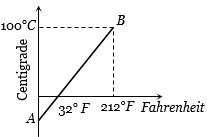
The graph $AB$ shown in figure is a plot of temperature of a body in degree celsius and degree Fahrenheit. Then
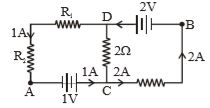
In the circuit shown below, if the potential at point $A$ is taken to be zero, the potential at point $B$ is .............. $V$
A spherical bubble inside water has radius $R$. Take the pressure inside the bubble and the water pressure to be $p_0$. The bubble now gets compressed radially in an adiabatic manner so that its radius becomes $(R-a)$. For $a \ll R$ the magnitude of the work done in the process is given by $\left(4 \pi p_0 R a^2\right) X$, where $X$ is a constant and $\gamma=C_p / C_V=41 / 30$. The value of $X$ is. . . . . .
In a wire of length $L,$ the increase in its length is $l.$ If the length is reduced to half, the increase in its length will be