- A0.1mol dm–3 NH4OH and 0.1mol dm–3 HCl.
- B0.05mol dm–3 NH4OH and 0.1mol dm–3 HCl.
- C0.1mol dm–3 NH4OH and 0.05mol dm–3 HCl.
- D0.1mol dm–3 CH4COONa and 0.1mol dm–3 NaOH.
Explanation:
In (c), all HCl will be neutralized and NH4Cl will be formed. Also some NH4OH will be left unneutralized. Thus, the final solution will contain NH4OH and NH4Cl and hence will form a buffer.
Generate a complete, print-ready paper with questions like this in minutes — across 16+ boards, with answer keys.
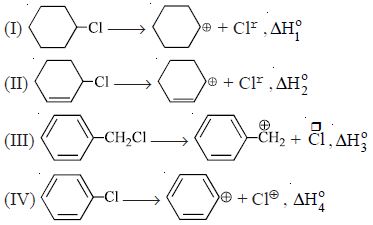
The correct decreasing order of enthalpies of reaction for producing carbocation is
$(A)$Covalent radius decreases down the group from $\mathrm{C}$ to $\mathrm{Pb}$ in a regular manner.
$(B)$ Electronegativity decreases from $\mathrm{C}$ to $\mathrm{Pb}$ down the group gradually.
$(C)$ Maximum covalence of $\mathrm{C}$ is $4$ whereas other elements can expand their covalence due to presence of $d$ orbitals.
$(D)$ Heavier elements do not form $\mathrm{p} \pi-p \pi$ bonds.
$(E)$ Carbon can exhibit negative oxidation states.
Choose the correct answer from the options given below:
| List $-I$ | List $-II$ |
| $(A)$ Phenelzine | $(p)$ Pyrimidine |
| $(B)$ Chloroxylenol | $(q)$ Furan |
| $(C)$ Uracil | $(r)$ Hydrazine |
| $(D)$ Ranitidine | $(s)$ Phenol |
(Nearest integer)
[Atomic weight : $\mathrm{H}=1.008 ; \mathrm{C}=12.00 ; \mathrm{O}=16.00$ ]