Which of the following wiring diagrams could be used to experimentally determine $R$ using ohm's law? Assume an ideal voltmeter and an ideal ammeter.
- A

- B

- C

- D

Medium


Download our appand get started for free
Experience the future of education. Simply download our apps or reach out to us for more information. Let's shape the future of learning together!No signup needed.*
Similar Questions
- 1In a potentiometer arrangement, a cell of $emf$ $1.25\; V$ gives a balance point at $35.0\; cm$ length of the wire. If the cell is replaced by another cell and the balance point shifts to $63.0\; cm ,$ what is the $emf$ of the second cell in $V$?View Solution
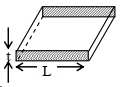
- 2Consider a thin square sheet of side $\mathrm{L}$ and thickness $\mathrm{t}$, made of a material of resistivity $\rho$. The resistance between two opposite faces, shown by the shaded areas in the figure isView Solution
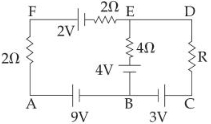
- 3In the electric network shown, when no current flows through the $4\, \Omega $ resistor in the arm $EB$, the potential difference between the points $A$ and $D$ will be ............... $V$View Solution
- 4Voltmeters $V_1$ and $V_2$ are connected in series across a $D.C.$ line. $V_1$ reads $80\, volts$ and has a per volt resistance of $200 \,\Omega$. $V_2$ has a total resistance of $32 \,kilo-ohms$. The line voltage is .............View Solution
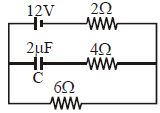
- 5Find the charge on the capacitor $C$ in the following circuit ............. $\mu C$View Solution
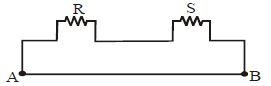
- 6In a meter bridge, the null point is found at a distance of $25\, cm$ from $A$. If now a resistance of $10\,\Omega $ is connected in parallel with $S$, the null point occurs at mid point of $AB$. The value of $R$ is ................. $\Omega$View Solution
- 7The length of a potentiometer wire is $l$. $A$ cell of $\mathrm{emf}$ $E$ is balanced at a length $l/3$ from the positive end of the wire. If the length of the wire is increased by $l/2$. At what distance will the same cell give a balance point.View Solution
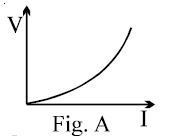
- 8The variation of current $(I)$ and voltage $(V)$ is as shown in figure $A$. The variation of power $P$ with current $I$ is best shown by which of the following graphView Solution
- 9Four wires of the same diameter are connected in turn between two points, maintained at a constant potential difference. Their resistivities are; $\rho $ and $L$ (wire $1$ )., $1.2\,\rho $ and $1.2\,L$ (wire $2$ ), $0.9\,\rho $ and $0.9\,L$ (wire $3$ ) and $\rho $ and $1.5\,L$ (wire $4$ ). Rank the wires according to the rates at which energy is dissipated as heat, greatest firstView Solution
- 10In a potentiometer arrangement, a cell of $emf$ $1.25\; V$ gives a balance point at $35.0\; cm$ length of the wire. If the cell is replaced by another cell and the balance point shifts to $63.0\; cm ,$ what is the $emf$ of the second cell in $V$?View Solution