MCQ
Which of the given method can't produce $Cl_2$
  • A
    Electrolysis of brine
  • B
    Deacon's process
  • Heating $MnO_2$ with conc. $HCl$
  • D
    Heating $KCl$ with conc. $H_2SO_4$

Answer

Correct option: C.
Heating $MnO_2$ with conc. $HCl$
c
Correct order of bond dissociation enthalpy of halogens is $Cl _{2} > Br _{2} > F _{2} > I _{2}$.

Due to inter electronic repulsions $F - F$ bond becomes weak and easily broken.

Need a full question paper?

Generate a complete, print-ready paper with questions like this in minutes — across 16+ boards, with answer keys.

Start Generating Free

Similar questions

Minimum ionic radius in $N-$ family
Ozonolysis of $ClO _2$ produces an oxide of chlorine. The average oxidation state of chlorine in this oxide is. . . . . 
The compound that will undergo $S_N 1$ reaction with the fastest rate is
Identify the product $Y$ in the sequence$C{H_3}CHO + C{H_3}Mgl\xrightarrow{{{\text{Ether}}}}X\xrightarrow{{{H_2}O/{H^ + }}}Y$
$28.0\,L$ of $CO _2$ is produced on complete combustion of $16.8\,L$ gaseous mixture of ethene and methane at $25^{\circ}\,C$ and $1\,atm$. Heat evolved during the combustion process is $.........\,kJ$.Given : $\Delta H _{ C }\left( CH _4\right)=-900\,kJ\,mol ^{-1}$ $\Delta H _{ C }\left( C _2 H _4\right)=-1400\,kJ\,mol ^{-1}$
The degree of dissociation of $Ca{(N{O_3})_2}$ in a dilute aqueous solution containing $7\,g$ of the salt per $100\,g$ of water ${100\,^o}C$ is $70$ percent. If the vapour pressure of water at ${100\,^o}C$ is $760 \,mm$. Calculate the vapour pressure of the solution .............. $\mathrm{mm}$ of $\mathrm{Hg}$
Most powerful oxidizing property of manganese is shown by which of the following oxidation state
When the principal quantum number $(n = 3)$, the possible values of azimuthal quantum number ($l$) is
The $IUPAC$ name of acetyl acetone is :
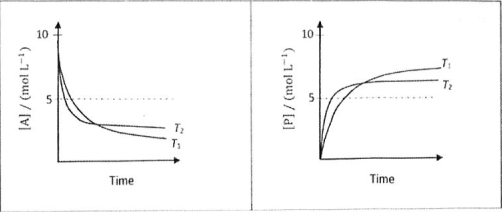
For a reaction, $A \rightleftharpoons P$, the plots of $[ A ]$ and $[ P ]$ with time at temperatures $T _1$ and $T _2$ are given below.

If $T _2> T _1$, the correct statement(s) is (are)

(Assume $\Delta H ^{\ominus}$ and $\Delta S ^{\ominus}$ are independent of temperature and ratio of $\ln K$ at $T _1$ to $\ln K$ at $T_2$ is greater than $T_2 / T_1$. Here $H, S, G$ and $K$ are enthalpy, entropy, Gibbs energy and equillibrium constant, respectively.)

$(A)$ $\Delta H ^{\ominus}<0, \Delta S ^{\ominus}<0$  $(B)$ $\Delta G ^{\ominus}<0, \Delta H ^{\ominus}>0$  $(C)$ $\Delta G ^{\ominus}<0, \Delta S ^{\ominus}<0$  $(D)$ $\Delta G ^{\ominus}<0, \Delta S ^{\ominus}>0$