MCQ
Which of the order for ionization energy is correct?
- A$Be < B < C < N < O$
- ✓$B < Be < C < O < N$
- C$Be > B > C > N > O$
- D$B < Be < N < C < O$
On moving from left to right in a period, with increase in the atomic number, the ionisation enthalpy increases.
However there are few exceptions
$(1)$ Ionization energy of $B\,<\,$ ionization energy of $B e$. This is because less amount of energy is required to remove a p electron than s electron from the same principal quantum shell.
$(2)$ Ionization energy of $O\, <\,$ ionization energy of $N$.
Nitrogen has half filled $2 p$ subshell which is very stable. More energy is required for removal of electron from half filled, stable subshell.
Generate a complete, print-ready paper with questions like this in minutes — across 16+ boards, with answer keys.
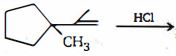
Product $(A)$ and $(B)$ is differentiated by
$Cl_2 + 2e^-\to 2CI^{\Theta }$ ; $E^o = 1.36\, V$
$Mn^{+3} + e^-\to Mn^{+2}$ ; $E^o = 1.50\, V$
$Fe^{+3} + e^-\to Fe^{+2}$ ; $E^o = 0.77\, V$
Which of the following is a correct statement