Question
Which of the order for ionization energy is correct?
On moving from left to right in a period, with increase in the atomic number, the ionisation enthalpy increases.
However there are few exceptions
$(1)$ Ionization energy of $B\,<\,$ ionization energy of $B e$. This is because less amount of energy is required to remove a p electron than s electron from the same principal quantum shell.
$(2)$ Ionization energy of $O\, <\,$ ionization energy of $N$.
Nitrogen has half filled $2 p$ subshell which is very stable. More energy is required for removal of electron from half filled, stable subshell.
Generate a complete, print-ready paper with questions like this in minutes — across 16+ boards, with answer keys.
Given : $AB$ is $100\%$ ionised at boiling point of the solution, ($K_b / K_f $) water $= 0.3$
When attached to $sp^3$ -hybridized carbon, their leaving group ability in nucleophilic substitution reaction decreases in the order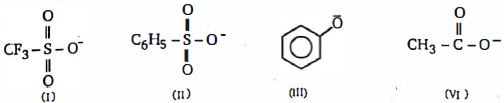
The Gibbs free energy change for the above reaction at $298\, K$ is $x \times 10^{-1} \,k\,J\, mol ^{-1}$;
The value of $x$ is ..... [nearest integer]$\left [\text { Given : } E _{ Cu ^{2} / / Cu }=0.34\, V ; E _{ Sn ^{2} / Sn }^{\ominus}=-0.14 \,V ; F=96500\, C\, mol ^{-1}\right]$
(image) $\xrightarrow{{B{r_2}/{H_2}O}}$ product