MCQ
Which of the statements is not true?
  • A
    On passing $H_2S$ through acidified $K_2Cr_2O_7$ solution, a milky colour is observed.
  • $Na_2Cr_2O_7$ is preferred over $K_2Cr_2O_7$ in volumetric analysis.
  • C
    $K_2Cr_2O_7$ solution in acidic medium is orange.
  • D
    $K_2Cr_2O_7$ solution becomes yellow on increasing the $pH$ beyond $7$
Answer

Correct option: B.
$Na_2Cr_2O_7$ is preferred over $K_2Cr_2O_7$ in volumetric analysis.
b
Nylon $- 66$ is a fibre as in it the forces of attraction are $H-$ bonding not a elastomer.

All other given statements are true.

Need a full question paper?

Generate a complete, print-ready paper with questions like this in minutes — across 16+ boards, with answer keys.

Start Generating Free

Similar questions

Chlorine water on standing loses its colour and forms
Which are not cleaved by $HIO_4$ ?

$I :$ glycerol                                           $II : $ glycol

$III : 1 , 3-$ propenediol                  $IV :$ methoxy $ -2- $ propanol

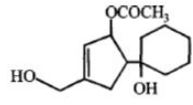
The major product formed in the following reaction is

$[Figure]$  $\xrightarrow[{CHC{l_3}}]{{\mathop {\left( {Pyridinium\,chlorochromate} \right)}\limits^{PCC} }}$

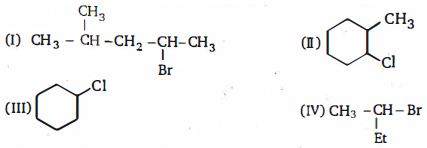
Among the given halides, which one will give same product in both $S_{N^1}$ and $S_{N^2}$ reactions
The standard electrode potential are given

$E^o_{Fe^{+2}/Fe} =-0.44\,V$ and $ E^o_{H^+ / O_2 / H_2O} =1.23\, V$

Calculate the $E^o_{cell}$ of the corrosion :- ............. $\mathrm{V}$

The number of unpaired electrons is maximum in (Atomic no. : $ Ti = 22; V= 23; Cr = 24; Fe = 26$)
It has been found that for a chemical reaction with rise in temperature by $9\, K$ the rate constant gets doubled. Assuming a reaction to be occurring at $300\, K$, the value of activation energy is found to be $......\,k\,J \,mol ^{-1}$. [nearest integer]

(Given $\ln 10=2.3, R =8.3 JK ^{-1} mol ^{-1}, \log 2=0.30$ )

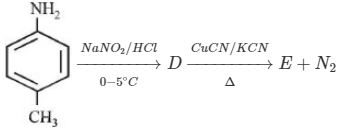
In the given reaction the product $E$ is :
The type of isomerism present in pentamine nitro chromium $(III) $ chloride is
An organic compound $(A)$ (molecular formula $\left. C _{6} H _{12} O _{2}\right)$ was hydrolysed with dil. $H _{2} SO _{4}$ to give a carboxylic acid $(B)$ and an alcohol $(C).$ $'C'$ give white turbidity immediately when treated with anhydrous $ZnCl _{2}$ and conc. $HCl$. The organic compound $(A)$ is