Question
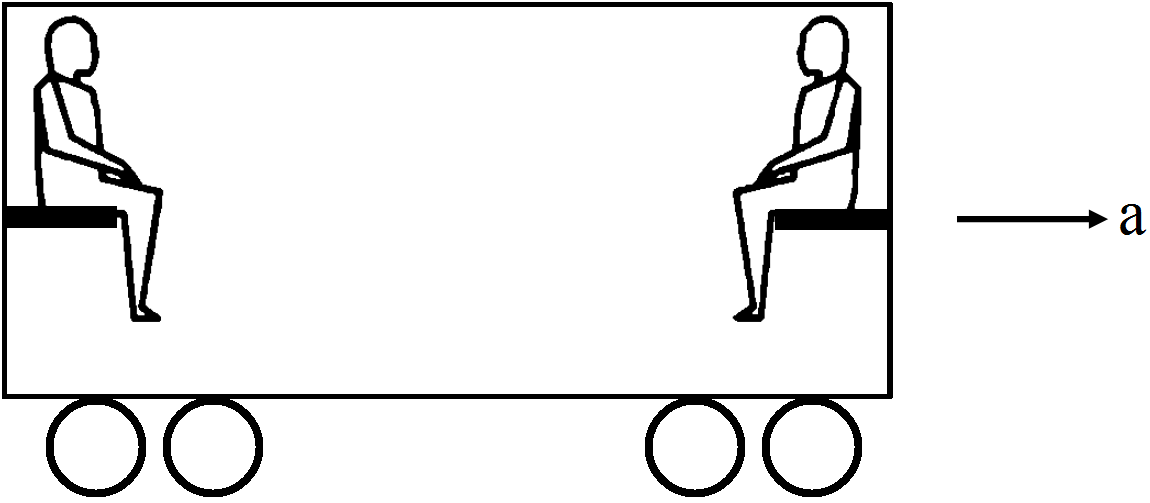
Which of the two persons shown in figure is more likely to fall down? Which external force is responsible for his falling down?
100%

Answer

The person sitting on right side of the figure is likely to fall Because of moment of inertia of the body of person his upper body is still in rest but lower body that is in contact with seat due to friction may move forward (right) as center of mass may be at the center of body the man may fall towards left.

Need a full question paper?

Generate a complete, print-ready paper with questions like this in minutes — across 16+ boards, with answer keys.
Start Generating Free

Similar questions

If two waves of the same frequency but of different amplitudes travelling in opposite directions through a medium superpose upon each other, will they form stationary wave? Is energy transferred? Are there any nodes?
A particle performing simple harmonic motion makes 1200 oscillations per minute and its velocity while passing through the mean position is $3.14 m / s$ lives. Also obtain the displacement equation of the particle if the displacement at moment $t=0$.
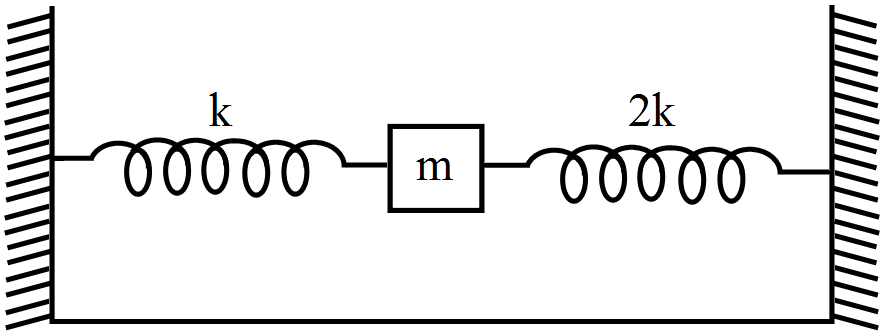
Two springs of force constants K and 2K are connected to a block of m as shown below. What is the frequency of oscillation of this block?
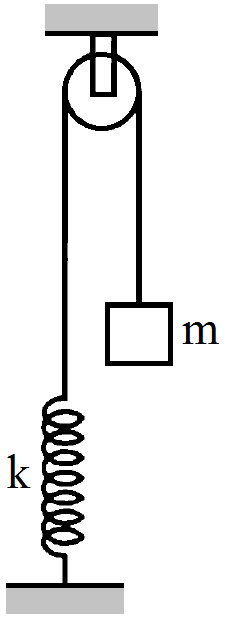
Consider the situation shown in figure. Initially the spring is unstretched when the system is released from rest. Assuming no friction in the pulley, find the maximum elongation of the spring.
Prove that the vectors $(\hat{\text{i}}+2\hat{\text{j}}+3\hat{\text{k}})$ and $(2\hat{\text{i}}-\hat{\text{j}})$ are perpendicular to each other.
It is heard sometime that mercury is used in defining the temperature scale because it expands uniformly with temperature. If the temperature scale is not yet defined, is it logical to say that a substance expands uniformly with temperature?
Does a body at 20°C radiate in a room, where the room temperature is 30°C? If yes, why does its temperature not fall further?
Disc of mass $M$ and radius $R$ are fixed on the edges of a massless rod of length $2 R$. Find the moment of inertia of this system perpendicular to the rod and relative to the axis passing through its center.
Give the magnitude and direction of the net force acting on a stone of mass 0.1kg, (Neglect air resistance throughout.) Just after it is dropped from the window of a train running at a constant velocity of 36km/h.
From two wires of a metal equal weights are suspended. One of the wire is 2 m long and has diameter of 1 mm and the second has length 1m and diameter 0.5 mm. Find the ratio of increases in length of these.