MCQ
Which of these adaptations helps to keep animals cool?
  •  Big thin ears
  • B
    Thick eye-lashes
  • C
    Scales on the body
  • D
    Thick fur on the body

Answer

Correct option: A.
 Big thin ears
Big thin ears

Need a full question paper?

Generate a complete, print-ready paper with questions like this in minutes — across 16+ boards, with answer keys.

Start Generating Free

Similar questions

The table below shows some common symptoms of nutrient deiciency.
Type of nutrient Symptoms due to its deiciency
Vitamin $A$ Poor vision, loss of vision at night
Calcium Weak bones, tooth decay
Vitamin $C$ Bleeding gums, wounds take longer to heal
Iodine Glands in the neck appear swollen
$6.$Pankaj is suffering from tooth decay and bleeding gums.
Which of the following nutrients in food would help him recover?
$A.$ Vitamin $A$ and calcium
$B.$ Calcium and vitamin $C$
$C.$ Vitamin $C$ and iodine
$D.$ Iodine and vitamin $A$
$7.$ Doctors advise not to boil fruits before eating.
What could be the likely reason for this? Circle $‘Yes’$ or $‘No’$ for each statement.
Why should fruits not be boiled before eating? $Yes$ or $No$?
Heating changes the colour of the fruit. $Yes/No$
Heating makes the fruit become soft. $Yes/No$
Heating destroys the vitamins present in the fruit. $Yes/No$
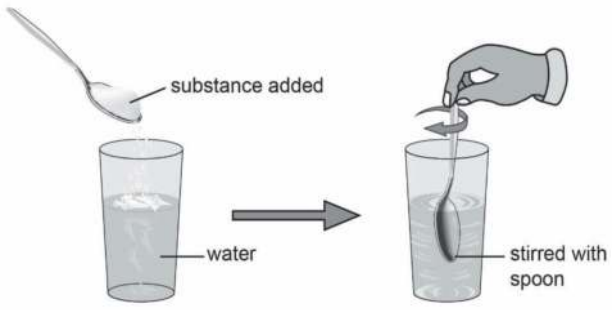
Anu adds sugar and salt to two separate glasses of water.
She stirs the mixture in each glass every time she adds salt or sugar to it.Image

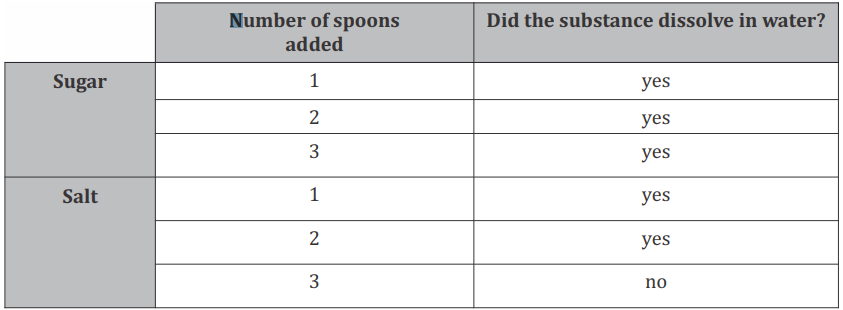
She notes her indings in a table.
Image
$3.$ What can Anu conclude from her activity?
$A.$ Sugar and salt dissolve equally in water.
$C.$ Stirring helps in dissolving all substances in a liquid.
$B.$ Sugar is more soluble than salt in water.
$D.$ Sugar forms a saturated solution in water but salt does not.
$4.$ Anu used two spoons of the same size to add sugar and salt to water.
What else did Anu need to keep the same for her activity?
$5.$ Anu repeats the activity using hot water.
Will the results in the table remain the same? Explain your answer
$6.$ Which of these processes could be used to separate the salt dissolved in the glass of water?
$A.$ Filtration
$B.$ Evaporation
$C.$ Condensation
$D.$ Sedimentation


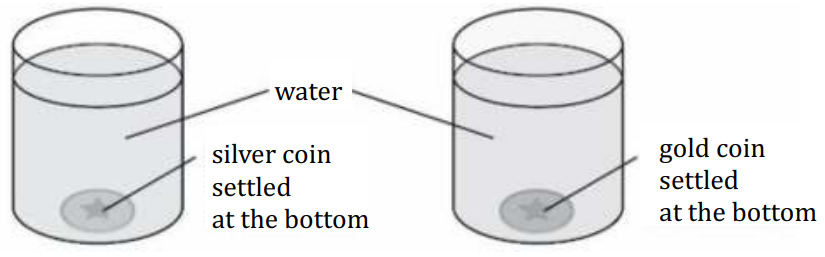
Rajiv dropped a silver and a gold coin each in a jar of water.
The picture below shows what happened.Image
$2.$ Which question can be answered from the activity?
Image
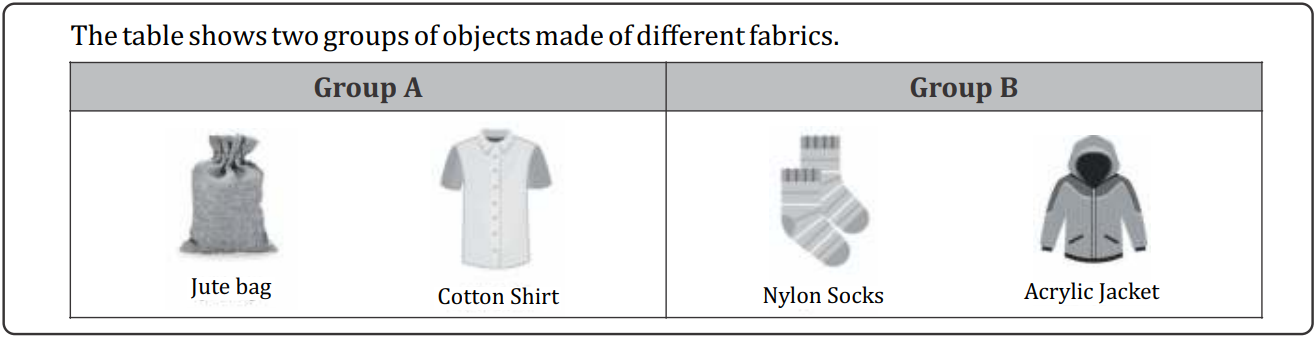
$3.$Which feature was used to group the fabrics?
$A.$ Shiny/Dull
$B.$ Rough/Smooth
$C.$ Natural/Synthetic
$D.$ Animal ibre/Plant ibre
$4.$What is the correct sequence for making cotton shirt from cotton balls?
$A.$ Fabric spun into fibres $\rightarrow $Fibres woven into yarn
$B.$ Fibres spun into yarn $\rightarrow $Yarn woven into fabric
$C.$ Yarn woven into fabric $\rightarrow $ Fabric spun into fibres
$D.$ Yarn knitted into fibres$ \rightarrow $ Fibres woven into fabric
$5.$Which part of a cotton plant is used to obtain cotton balls?
$A.$ Fruit
$B.$ Stem
$D.$ Leaves
$C.$ Flowers

Image
$2.$How was the wool ball made?

Image
$1.$ What does Sudhir’s activity show?
Rohan wants to ind out which type of fabric best absorbs water.
He soaks four different types of fabrics in water for $15$ minutes.
He places each fabric on a sieve and allows the water to drain.
He then measured the mass of the wet fabrics.
Fabric type Mass of the wet fabric
Cotton $120\ g$
Silk $100\ g$
Polyester $85\ g$
Wool $110\ g$
$6.$What extra information does Rohan need to ind out which fabric best absorbs water?
$A.$ The time each fabric took to dry completely
$B.$ The mass of each fabric before soaking in water
$C.$ The amount of water in which the fabrics were soaked
$D.$ The temperature of the water in which the fabrics were soaked
$7.$What does Rohan need to keep the same for all the four fabrics?
Circle $‘Yes’$ or $‘No’$ for each row
Should this be kept same for all the four fabrics? $Yes$ or $No$
The colour of the fabrics $Yes/No$
The size of the fabrics $Yes/No$
The thickness of the fabrics $Yes/No$
Fat-rich foods leave an oily patch on paper when smashed or rubbed on it.
Raju wanted to check this through an activity.
He performed the following steps.
Step $1:$ Placed a fat-rich food item on a piece of white paper
Step $2:$ Smashed the food gently with a hammer
Step $3:$ Removed the smashed food from the paper
Step $4:$ Dried the paper and then checked for any patch on it
$8.$ In Step $4$, Raju dried the paper before checking for patches.
What could be the most likely reason for this?
$9.$Raju performed the same activity with four types of food.
Which of the following will decide the amount of fat in each food item?
$A.$ The shape of the paper
$B.$ Time taken for the paper to dry
$C.$ The size of the oily patch on the paper
$D.$ Ease of smashing the food with hammer
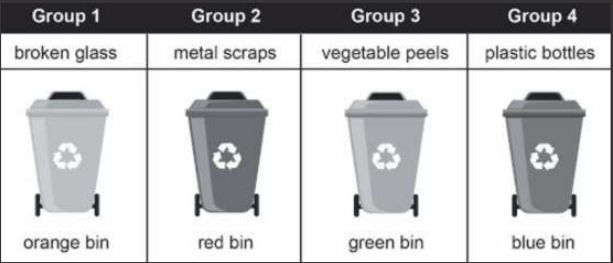
The table shows different bins used to collect different types of wastes
.Image
$1.$ The waste from which bin is suitable for composting?
$A.$ Orange
$B.$ Red
$C.$ Green
$D.$ Blue
$2.$ A children’s park has only green and blue bins.
In which bin should empty juice cans be dumped? Explain your answer.
$3.$ Why should we recycle materials?
Circle $‘Yes’ $ or $‘No’$ for the correct response.
Why do we recycle materials? $Yes$ or $No$
To save natural resources $Yes/No$
To make products stronger $Yes/No$
To create beautiful products $Yes/No$
$4.$ Why is burning of crop residue harmful?
$5.$ WWhich of these is an example of reducing waste at home?
Circle $‘Yes’$ or $‘No’ $ for the correct response.
Will this reduce waste? $Yes$ or $No$
Buying use-and-throw pens $Yes/No$
Using old cloth to make grocery bags $Yes/No$
Reusing cookie jars to store sugar $Yes/No$
$6.$ Why should plastic waste not be dumped in landills?
$A.$ It has a low melting point.
$B.$ It does not degrade over time.
$C.$ It reacts with some vegetable wastes.
$D.$ It produces harmful gases on burning.
$7.$ Should plastic waste be dumped in water bodies? Explain your answer.
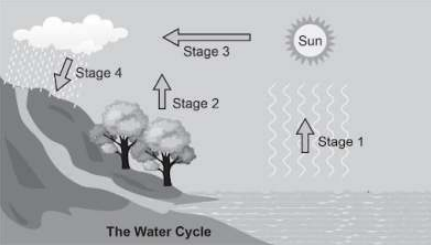
The picture shows the four different stages of the water cycle.Image
$5.$ Which stage shows the process of transpiration?
$A.$ Stage $1$
$B.$ Stage $2$
$C.$ Stage $3$
$D.$ Stage $4$
$6.$ In which stage does water vapour condense to form water droplets?
$A.$ Stage $1$
$B.$ Stage $2$
$C.$ Stage $3$
$D.$ Stage $4$
$7.$ On which day will stage $1$ of the water cycle progress the slowest?
$A.$ A hot and sunny day
$B.$ A cold and sunny day
$C.$ A hot and cloudy day
$D.$ A cold and cloudy day
$8.$ Which of the following statements about the water cycle is true?
Circle $‘Yes’$ or $‘No’$ for the correct response.
Is the statement about the water cycle true? $Yes$ or $No$
Some water is lost to the space during the water cycle. $Yes/No$
Water from the ocean and land goes into air as vapour. $Yes/No$
Water cycle is a continuous process. $Yes/No$