MCQ
Which one does not exhibit paramagnetism
  • A
    $Cl{O_2}$
  • $ClO_2^ - $
  • C
    $N{O_2}$
  • D
    $NO$

Answer

Correct option: B.
$ClO_2^ - $
(b) $ClO_2^ - $ has all paired electrons hence it does not show paramagnetism.

Need a full question paper?

Generate a complete, print-ready paper with questions like this in minutes — across 16+ boards, with answer keys.

Start Generating Free

Similar questions

The values of $K_{sp}$ of $CaCO_3$ and $CaC_2O_4$ are $4.7 \times 10^{-9}$ and $1.3 \times 10^{-9}$ respectively at $25\,^oC.$ If the mixture of these two is washed with water, what is the concentration of $Ca^{2+}$ ions in water ..............$ \times 10^{-5}\, M$?
Match List$-I$ with List$-II$ :
$LIST-I
($Precipitating reagent and
conditions)
$LIST-II
($Cation$)$
$A.$ $NH_4Cl + NH_4OH$ $I.$ $Mn^{2+}$
$B.$ $NH_4OH + Na_2CO_3$ $II.$ $Pb^{2+}$
$C.$ $NH_4OH + NH_4Cl + H_2S$ gas $III.$ $Al^{3+}$
$D.$ dilute $HCl$ $IV.$ $Sr^{2+}$
Choose the correct answer from the options given below :
Assertion : Trans $-2-$ butene on reaction with $Br_2$ gives meso $-2, 3-$ dibromobutane.

Reason : The reaction involves syn-addition of bromine.

The difference in energy between the actual structure and the lowest energy resonance structure for the given compound is
For which of the following sets of quantum numbers, an electron will have the highest energy?
Consider the following reactions
$K _2 Cr _2 O _7 \xrightarrow[- H _2 O ]{ KOH }[ A ] \xrightarrow[- H _2 O ]{ H _2 SO _4}[B]+ K _2 SO _4$
The products [A] and [B], respectively are :
Element not showing variable oxidation state is :
Decreasing order of stability of

$(a)$ $C{H_3} - \mathop C\limits^ \oplus  H - C{H_3}$

$(b)$ $C{H_3} - \mathop C\limits^ \oplus  H - OC{H_3}$

$(c)$ $C{H_3} - \mathop C\limits^ \oplus  H - CO - C{H_3}$
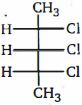
Number of diastereomer of given compound
The number of species from the following that are involved in $\mathrm{sp}^{3} \mathrm{~d}^{2}$ hybridization is $\left[\mathrm{Co}\left(\mathrm{NH}_{3}\right)_{6}\right]^{3+}, \mathrm{SF}_{6},\left[\mathrm{CrF}_{6}\right]^{3-},\left[\mathrm{CoF}_{6}\right]^{3-},\left[\mathrm{Mn}(\mathrm{CN})_{6}\right]^{3-}$ and $\left[\mathrm{MnCl}_{6}\right]^{3-}$