MCQ
Which one given below is a non-reducing sugar ?
  • A
    Glucose
  • Sucrose
  • C
    Maltose
  • D
    Lactose

Answer

Correct option: B.
Sucrose
b
sucrose is non-reducing sugar because it has one $-CHO$ group

Need a full question paper?

Generate a complete, print-ready paper with questions like this in minutes — across 16+ boards, with answer keys.

Start Generating Free

Similar questions

Which of the following molecules has the maximum dipole moment ?
For an exothermic reaction $A \to B$ , the activation energy is $65\ kJ mol^{-1}$ and heat of reaction is $-42\ kJ mol^{-1}$. The activation energy for the reaction $B \to A$ would be....... $kJ\, mol^{-1}$
Phenyl isocyanides are prepared from which of the following reactions
Standard reduction potentials of the half reactions are given below :

$F_{2(g)} + 2e^- \rightarrow 2F^-_{(aq)}\, ;$  $E^o = + 2.85\, V$

$Cl_{2(g)} + 2e^- \rightarrow 2Cl^-_{(aq)}\, ;$   $E^o = + 1.36\, V$

$Br_{2(l)} + 2e^- \rightarrow 2Br^-_{(aq)}\, ;$  $E^o = + 1.06\, V$

$I_{2(s)} + 2e^- \rightarrow 2I^-_{(aq)}\, ;$  $E^o = + 0.53\, V$

The strongest oxidising and reducing agents respectively are
If in $NH_3$ formation $N$ uses its pure atomic orbital then wrong statement is
A $5.25\%$ solution of a substance is isotonic with a $1.5\%$ solution of urea (molar mass $= 60\, g\, mol^{-1}$) in the same solvent. If the densities of both the solutions are assumed to be equal to $1.0\,g\, cm^{-3},$ molar mass of the substance will be .............. $\mathrm{g\,mol}^{-1}$
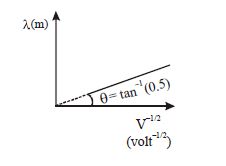
Observe the following graph for the de-Broglie wavelength of a hypothetical charged particle $(q = 1.6 × 10^{-19}\,C)$. Find the mass of the particle $(h = 6.0 × 10^{-34}\ J-s)$
A certain atomic transition from an excited state to the ground state of the hydrogen atom in one or more steps give rise to four line in the ultraviolet region of the spectrum. How many lines does this transition produce in the infrared region of the spectrum
$C{H_3} - C \equiv CH\xrightarrow{{Na}}X\xrightarrow{{C{H_3} - Cl}}Y$ , 

$Y$ is

Which is the incorrect observation ?