MCQ
Which one in the following contains ionic as well as covalent bond
  • A
    $C{H_4}$
  • B
    ${H_2}$
  • $KCN$
  • D
    $KCl$

Answer

Correct option: C.
$KCN$
(c) Structure of $KCN$ is $[{K^ + }({C^ - } \equiv \mathop N\limits^{.\,\,.} )]$.

Need a full question paper?

Generate a complete, print-ready paper with questions like this in minutes — across 16+ boards, with answer keys.

Start Generating Free

Similar questions

Which of the following is anhydride of perchloric acid
Which one given below is a non-reducing sugar ?
Based on the data given below:
$\begin{array}{l}
E_{Cr_2 O_7^{2-} / Cr^{3+}}^0=1.33 V \quad E_{C_2 / Cr^{(-1}}^0=1.36 V \\
E_{MnO_4^{-} / Mn^{2+}}^0=1.51 V \quad E_{Cr^{2+} / Cr}^0=-0.74 V
\end{array}
$
the strongest reducing agent is :
Which of the following statements are not correct?

$A.$ The electron gain enthalpy of $F$ is more negative than that of $Cl$

$B.$ Ionization enthalpy decreases in a group of periodic table

$C.$ The electronegativity of an atom depends upon the atoms bonded to it.

$D.$ $Al _2 O _3$ and $NO$ are examples of amphoteric oxides.

Choose the most appropriate answer from the options given below:
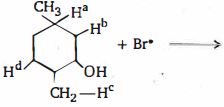
$Br^\bullet $ will abstract which of the hydrogen most readily ?
The sum of $IE_1$ and $IE_2$. $IE_3$ and $IE_4$ for elements $P$ and $Q$ are given below

$(IE_1 + IE_2)$ $(IE_3 + IE_4)$
$(P)$ $2.45\, KJ/mol$ $8.82\, KJ/mol$
$(Q)$ $2.85\, KJ/mol$ $6.11\, KJ/mol$

then according to given information the incorrect statements is/are

The $IUPAC$ name of $\begin{matrix}
   C{{H}_{3}}-CH-C{{H}_{2}}-O-{{C}_{2}}{{H}_{5}}  \\
   |\,\,\,\,\,\,\,\,\,\,\,\,\,\,\,\,\,\,\,\,\,\,\,\,\,\,\,\,\,\,\,\,\,\,\,\,\,  \\
   OH\,\,\,\,\,\,\,\,\,\,\,\,\,\,\,\,\,\,\,\,\,\,\,\,\,\,\,\,\,\,\,\,\,  \\
\end{matrix}$ is
Ozonolysis products of an olefin are $OHC-CHO$ and $OHC-CH_2-CH_2-CHO$, the olefin is
The amount of charge required to liberate $9\, gm$ of aluminium (atomic weight = $27$ and valency = $3$) in the process of electrolysis is ......... $\mathrm{coulombs}$ (Faraday's number  $=96500\,coulombs/gm$ equivalent)
Assertion : $RCOCl, (RCO)_2O$ and $RCOOR$’ all react with Grignard reagents to form $3^o$ alcohols.
Reason : $RCOCl$ reacts with $R_2Cd$ to form ketones but $(RCO)_2O$ and $RCOOR'$ do not react at all.