MCQ
Which one is called ethanoic acid
  • A
    $HCOOH$
  • $C{H_3}COOH$
  • C
    $C{H_3}C{H_2}COOH$
  • D
    $C{H_3}C{H_2}C{H_2}COOH$

Answer

Correct option: B.
$C{H_3}COOH$
b

Need a full question paper?

Generate a complete, print-ready paper with questions like this in minutes — across 16+ boards, with answer keys.
Start Generating Free

Similar questions

Which is the only alcohol that can be prepared by the indirect hydration of alken?
Choose the correct option having all the elements with $\mathrm{d}^{10}$ electronic configuration from the following:
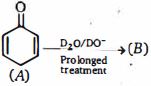
After prolonged treatment of $(A)$ by $D_2O/DO^-$ , the difference in molecular  weights of  compounds $(A)$ and $(B)$ is
A $5.25\%$ solution of a substance is isotonic with a $1.5\%$ solution of urea (molar mass $= 60\, g\, mol^{-1}$) in the same solvent. If the densities of both the solutions are assumed to be equal to $1.0\,g\, cm^{-3},$ molar mass of the substance will be .............. $\mathrm{g\,mol}^{-1}$
Which of the following is not a sex hormone
When anisole is heated with $HI$, the product is
Mixture of $PhCHO$ and $HCHO$ is treated with $NaOH$,then cannizzaro reaction  involve

$(A)$ Reduction of $HCHO$

$(B)$ Oxidation of $HCHO$

$(C)$ Reduction of $PhCHO$

$(D)$ Oxidation of $Ph-CHO$

Use the data given in and find out which of the following is the strongest oxidising agent:
$\text{E}^\ominus_{\text{cr}_2\text{O}^{2-}_7/\text{cr}^{3+}}=1.33\text{V}\ \ \ \text{E}^\ominus_{\text{Cl}_2/\text{Cl}^-}=1.36\text{V}$
$\text{E}^\ominus_{\text{MnO}^-_4/\text{Mn}^{2+}}=1.51\text{V}\ \ \ \ \text{E}^\ominus_{\text{Cr}^{3+}/\text{Cr}}=-0.74\text{V}$
Identify the correct set of reagents or reaction conditions ' $\mathrm{X}$ ' and ' $\mathrm{Y}$ ' in the following set of transformation.
The correct statement$(s)$ regarding, $(i)$ $HC1O$, $(ii)$ $HClO _2$, $(iii)$ $HClO _3$ and $(iv)$ $HClO _4$, is (are)

$(A)$ The number of $Cl = O$ bonds in $(ii)$ and $(iii)$ together is two

$(B)$ The number of lone pairs of electrons on $Cl$ in $(ii)$ and $(iii)$ together is three

$(C)$ The hybridization of $Cl$ in $(iv)$ is $sp ^3$

$(D)$ Amongst $(i)$ to $(iv)$, the strongest acid is $(i)$