MCQ
Which one is correct relation for thermionic emission
  • A
    $\ce{J=A T^{1 / 2} e^{-\emptyset / k T}}$
  • $\mathrm{J}=\mathrm{AT}^2 \mathrm{e}^{-\emptyset / \mathrm{kT}}$
  • C
    $\mathrm{J}=\mathrm{AT}^{3 / 2} \mathrm{e}^{-\emptyset / \mathrm{kT}}$
  • D
    $\ce{J=A T^2 e^{-\emptyset / 2 k T}}$

Answer

Correct option: B.
$\mathrm{J}=\mathrm{AT}^2 \mathrm{e}^{-\emptyset / \mathrm{kT}}$

Need a full question paper?

Generate a complete, print-ready paper with questions like this in minutes — across 16+ boards, with answer keys.

Start Generating Free

Similar questions

A spring-mass system occillates in a car. if the car accelerates on a horizontal road, the frequency of oscillation will:
  1. Increase.
  2. Decrease.
  3. Remain same.
  4. Become zero.
A uniform wire of resistance $R$ is uniformly compressed along its length, until its radius becomes $n$ times the original radius. Now resistance of the wire becomes
A radioactive nucleus undergoes a series of decay according to the scheme $A \xrightarrow{\alpha} A_1 \xrightarrow{\beta} A_2 \xrightarrow{\alpha} A_3 \xrightarrow{\gamma} A_4$ If the mass number and atomic number of $A$ are $180$ and $72$ respectively, then what are these number for $A_4$
Which of the following are electromagnetic waves?
  1. $\alpha-\text{decay}$
  2. $\beta^+-\text{decay}$
  3. $\beta^--\text{decay}$
  4. $\gamma-\text{decay}$
The ratio of secondary to the primary turns in a transformer is $3: 2.$ If the power output be $P,$ then the input power neglecting all loses must be equal to
In Young's double$-$slit experiment, the intensity of light at a point on the screen where the path difference is $\lambda$ is $k ( \lambda$ being the wavelength of light used$)$. The intensity at a point where the path difference is $\frac{\lambda}{4},$ will be
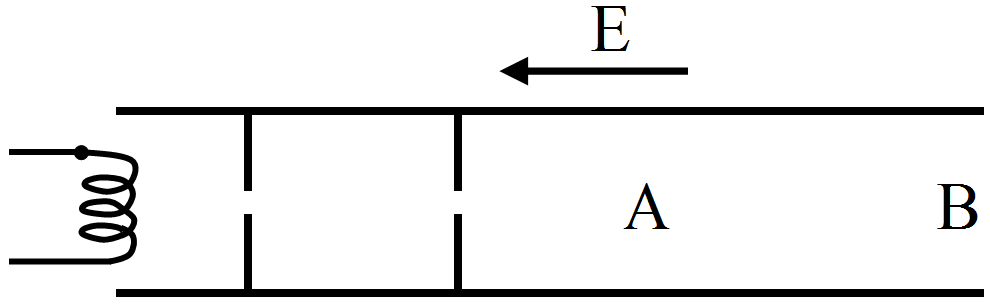
Electrons are emitted by a hot filament and are accelerated by an electric field, as shown in the figure. The two stops at the left ensure that the electron beam has a uniform cross-section.
  1. The speed of the electrons is more at B than at A.
  2. The electric current is from left to right.
  3. The magnitude of the current is larger at B than at A.
  4. The current density is more at B than at A.
An electron enters a region where magnetic (B) and electric (E) fields are mutually perpendicular to one another, then(a) It will always move in the direction of B(b) It will always move in the direction of E(c) It always possess circular motion(d) It can go undeflected also


A piece of wood is floating in water kept in a bottle. The bottle is connected to an air pump. Neglect the compressibility of water. When more air is pushed into the bottle from the pump, the piece of wood will float with.
  1. Larger part in the water.
  2. Lesser part in the water.
  3. Same part in the water.
  4. It will sink.
A man runs towards a mirror at a speed $15\ m/s$  The speed of the image relative to the man is