MCQ
Which one is not the property of charge?
  • A
    Charge is additive.
  • B
    Charge is conserved.
  • C
    Quantization of charge.
  • A charge is self-destructive.

Answer

Correct option: D.
A charge is self-destructive.
Electric charge possesses the properties of quantization, conservation of charge. It cannot be destroyed i.e. it is not self$-$destructive.

Need a full question paper?

Generate a complete, print-ready paper with questions like this in minutes — across 16+ boards, with answer keys.
Start Generating Free

Similar questions

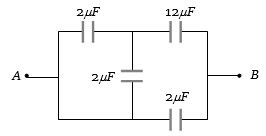
Four capacitors are connected in a circuit as shown in the figure. The effective capacitance in $\mu F$ between points $A$ and $B$ will be
A watch shows time as $3:25$ when seen through a mirror, time appeared will be
A sodium atom is in one of the states labeled 'Lowest excited levels'. It remains in that state for an average time of $10^{-8}\ sec$, before it makes a transition back to a ground state. What is the uncertainty in energy of that excited state
An electric motor operates on a 50 volt supply and a current of 12A. If the efficiency of the motor is 30%, what is the resistance of the winding of the motor
Huygen's conception of secondary waves
How much current should be passed through acidified water for 100 s to liberate 0.224 litre of $H_2$
Which of the following formula is correct for a spherical lens?
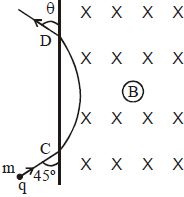
A particle of mass $m = 1.67 \times 10^{-27}\, kg$ and charge $q = 1.6 \times 10^{-19} \, C$ enters a region of uniform magnetic field of strength $1$ $tesla$ along the direction shown in the figure. the particle leaves the magnetic field at point $D,$ then the distance $CD$ is :-
A beam of plane polarized light falls normally on a polarizer of cross sectional area $3\times 10^{-4}m^2$. Flux of energy of incident ray in $10^{-3} \mathrm{~W}$. The polarizer rotates with an angular frequency of 31.4 rad/sec. The energy of light passing through the polarizer per revolution will be
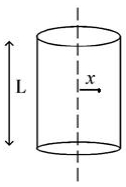
A long cylindrical volume contains a uniformly distributed charge of density $\rho \;Cm ^{-3}$. The electric field inside the cylindrical volume at a distance $x =\frac{2 \varepsilon_{0}}{\rho} m$ from its axis is $.......Vm ^{-1}$