MCQ
Which one of following is charge less ?
  • A
    Alpha particle
  • B
    Beta particle
  • Photon particle
  • D
    Proton

Answer

Correct option: C.
Photon particle
C

Need a full question paper?

Generate a complete, print-ready paper with questions like this in minutes — across 16+ boards, with answer keys.
Start Generating Free

Similar questions

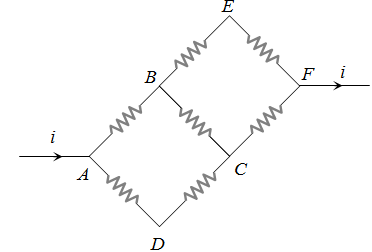
In the adjoining circuit diagram each resistance is of $10 W$. The current in the arm $AD$ will be
Number of electrons in one coulomb of charge will be
When a $4^{\mathrm{Be}^9}$ atom is bombarded with $\alpha -$  particles, one of the product of nuclear transmutation is ${ }_s 6^{C^{12}}$. The other is
An electric fan and a heater are marked as 100 watt, 220 volt and 1000 watt, 220 volt respectively. The resistance of the heater is(a) Zero(b) Greater than that of the fan(c) Less than that of the fan(d) Equal to that of the fan
   
   
The electron cannot exist inside the nucleus because:
The self induction takes place when magnetic flux through a coil:
Assertion  :  NAND or NOR gates are called digital building blocks.
Reason      : The repeated use of NAND (or NOR) gates can produce all the basic or complicated gates.(a) If both assertion and reason are true and the reason is the correct explanation of the assertion.(b) If both assertion and reason are true but reason is not the correct explanation of the assertion.(c) If assertion is true but reason is false.(d) If the assertion and reason both are false.


Consider the following two statements $A$ and $B$ and identify the correct choice given in the answers
$(A)$ Duddells thermo$-$galvanometer is suitable to measure direct current only
$(B)$ Thermopile can measure temperature differences of the order of $10^{-3}{ }^{\circ} \mathrm{C}$
In photoelectric effect, the K.E. of electrons emitted from the metal surface depends upon(a) Intensity of light(b) Frequency of incident light(c) Velocity of incident light(d) Both intensity and velocity of light
   
   
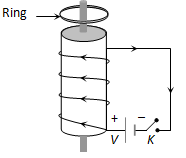
A conducting ring is placed around the core of an electromagnet as shown in fig. When key $K$ is pressed, the ring