MCQ
Which one of the following complexes exhibit chirality?
- ✓$[Cr(ox)_3]^3$
- Bcis $-[PtCl_2(en)]$
- Ccis $-[RhCl(NH_3)_4]^+$
- Dmer $-[Co(NO_2)_3(dien)]$
The complexes cis $-\left[ PtCl _2( en )\right]$, cis $-\left[ RhCl _2\left( NH _3\right)_4\right]^{+}$andmer $-\left[ Co \left( NO _2\right)_3(\right.$ dien $\left.)\right]$ contain symmetry elements and are achiral.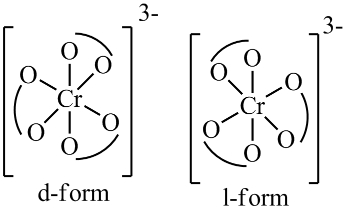
Generate a complete, print-ready paper with questions like this in minutes — across 16+ boards, with answer keys.
$\left\{ en = H _2 NCH _2 CH _2 NH _2\right.$; atomic numbers: $\left.Ti =22 ; Cr =24 ; Cp =27 ; Pt =78\right\}$
| List-$I$ | List-$II$ |
| $P.$ $\left[ Cr \left( NH _3\right)_4 Cl _2\right) Cl ]$ | $1.$ Paramagnetic and exhibits ionisation isomerism |
| $Q.$ $\left[ Ti \left( H _2 O \right)_5 Cl \right]\left( NO _3\right)_2$ | $2.$ Diamagentic and exhibits cis-trans isomerism |
| $R.$ $\left[ Pt ( en )\left( NH _3\right) Cl \right] NO _3$ | $3.$ Paramagentic and exhibits cis-trans isomerism |
| $S.$ $\left[ Co \left( NH _3\right)_4\left( NO _3\right)_2\right] NO _3$ | $4.$ Diamagentic and exhibits ionisation isomerism |
Codes: $ \quad P \quad Q \quad R \quad S $
$4B(s) + 3O_2\,(g) \rightarrow 2B_2O_3\,(g)$ ; $E^o_{cell} = 1.433$ $volt$ What is molar entropy (in $J/K$) of oxygen gas
Given ${\left( {{\Delta _f}{H^o}} \right)_{{B_2}{O_3}}}\left( g \right) = - 840\,\frac{{KJ}}{{mol}}$
${\left( {S_m^o} \right)_{{B_2}{O_3}}} \left( g \right) = 280J/K - mol$
${{(S_{m}^{o})}_{B}}\,\,\left( s \right)=10\,J/K-mol$
(Atomic no. $Ti = 22, V = 23, Cr = 24, Fe = 26$)