MCQ
Which one of the following complexes exhibit chirality?
- ✓$[Cr(ox)_3]^3$
- Bcis $-[PtCl_2(en)]$
- Ccis $-[RhCl(NH_3)_4]^+$
- Dmer $-[Co(NO_2)_3(dien)]$
The complexes cis $-\left[ PtCl _2( en )\right]$, cis $-\left[ RhCl _2\left( NH _3\right)_4\right]^{+}$andmer $-\left[ Co \left( NO _2\right)_3(\right.$ dien $\left.)\right]$ contain symmetry elements and are achiral.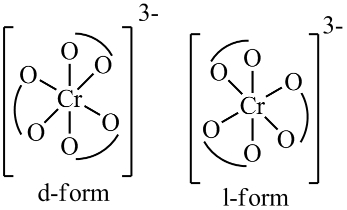
Generate a complete, print-ready paper with questions like this in minutes — across 16+ boards, with answer keys.
$A$. All the transition metals except scandium form $MO$ oxides which are ionic.
$B$. The highest oxidation number corresponding to the group number in transition metal oxides is attained in $Sc _2 O _3$ to $Mn _2 O _7$.
$C$. Basic character increases from $V _2 O _3$ to $V _2 O _4$ to $V _2 O _5$.
$D$. $V _2 O _4$ dissolves in acids to give $VO _4^{3-}$ salts.
$E$. $CrO$ is basic but $Cr _2 O _3$ is amphoteric.
Choose the correct answer from the options given below:
$STATEMENT-2$: The colour of the compound formed in the reaction of aniline with $\mathrm{NaNO}_2 / \mathrm{HCl}$ at $0^{\circ} \mathrm{C}$ followed by coupling with $\beta$-naphthol is due to the extended conjugation.