MCQ
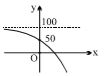
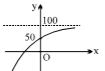
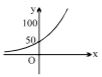
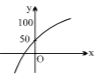
Which one of the following curves represents the solution of the initial value problem
$Dy = 100 - y,$  where $y (0) = 50$
  • A


  • C

  • D

Answer

Correct option: B.

b
$\int {\frac{{dy}}{{100 - y}}}  = \int {dx} $
$- \ln (100 - y) = x + C$
$\ln (100 - y) = - x + C$
$x = 0, y = 50$   hence $C = \ln 50$
$x = \ln 50 - \ln (100 - y)$
$\ln \frac{{50}}{{100 - y}} = x \,\, \Rightarrow \frac{{50}}{{100 - y}} = e^x$
$\Rightarrow 100 - y = 50e^{-x} $
$\Rightarrow y = 100 - 50e^{-x}$

Need a full question paper?

Generate a complete, print-ready paper with questions like this in minutes — across 16+ boards, with answer keys.

Start Generating Free

Similar questions

Let the system of linear equations $4 x+\lambda y+2 z=0$ ;  $2 x-y+z=0$ ;  $\mu x +2 y +3 z =0, \lambda, \mu \in R$ has a non-trivial solution. Then which of the following is true?
If $A = {\tan ^{ - 1}}x$, then $\sin 2A = $
If $\text{x}=\text{t}^2,\text{y}=\text{t}^3$ Then $\frac{\text{d}^2\text{y}}{\text{dx}^2}=$
  1. $\frac{3}{2}$
  2. $\frac{3}{4\text{t}}$
  3. $\frac{3}{2\text{t}}$
  4. $\frac{3\text{t}}{2}$
If the system of equations $\alpha x+y+z=5, x+2 y+$ $3 z=4, x+3 y+5 z=\beta$ has infinitely many solutions, then the ordered pair $(\alpha, \beta)$ is equal to:
Let $a, b, c > 0$ and $\Delta  = \left| \begin{gathered}
  a + b\,\,b\,\,c \hfill \\
  b\, + \,c\,\,c\,\,\,a \hfill \\
  c + a\,\,a\,\,b \hfill \\ 
\end{gathered}  \right| ,$ then which of the following is not correct?
A coin is tossed successively three times. The probability of getting exactly one head or $2$ heads, is
Let $\mathrm{f}: \mathrm{R}-\left\{\frac{-1}{2}\right\} \rightarrow \mathrm{R}$ and $\mathrm{g}: \mathrm{R}-\left\{\frac{-5}{2}\right\} \rightarrow \mathrm{R}$ be defined as $f(x)=\frac{2 x+3}{2 x+1}$ and $g(x)=\frac{|x|+1}{2 x+5}$. Then the domain of the function $fog$ is:
Let f: R → R be defined as f(x) = x4. Choose the correct answer.
  1. f is one-one onto
  2. f is many-one onto
  3. f is one-one but not onto
  4. f is neither one-one nor onto.
If $f(x) = \left\{ \begin{array}{l}x\frac{{{e^{(1/x)}} - {e^{( - 1/x)}}}}{{{e^{(1/x)}} + {e^{( - 1/x)}}}},\,x \ne 0\\\,\,\,\,\,\,\,\,\,\,\,\,\,\,\,\,\,\,\,\,\,\,\,\,\,\,\,\,\,0,\,x = 0\end{array} \right.$ then which of the following is true
The distance of the point (-1, -5, -10) from the point of intersection of the line $\vec{\text{r}}.=2\hat{\text{i}}-\hat{\text{j}}+2\hat{\text{k}}+\lambda(3\hat{\text{i}}+4\hat{\text{j}}+12\hat{\text{k}})$ and the plane $\vec{\text{r}}.=(\hat{\text{i}}-\hat{\text{j}}+\hat{\text{k}})=5$ is: