MCQ
Which one of the following does not represent a travelling wave
  • A
    $y = \sin (x - v\,t)$
  • B
    $y = {y_m}\sin k(x + v\,t)$
  • C
    $y = {y_m}\log (x - v\,t)$
  • $y = f({x^2} - v\,{t^2})$

Answer

Correct option: D.
$y = f({x^2} - v\,{t^2})$
d
(d) $y = f({x^2} - v{t^2})$ doesn’t follows the standard wave equation.

Need a full question paper?

Generate a complete, print-ready paper with questions like this in minutes — across 16+ boards, with answer keys.
Start Generating Free

Similar questions

A $100\, m$ long train is moving with a uniform velocity of $45\, km/hr$. The time taken by the train to cross a bridge of length $1 \,km$ is.........$s$
A constant torque acting on a uniform circular wheel changes its angular momentum from $A_0$ to $4A_0$ in $4\, second$. The magnitude of this toque is
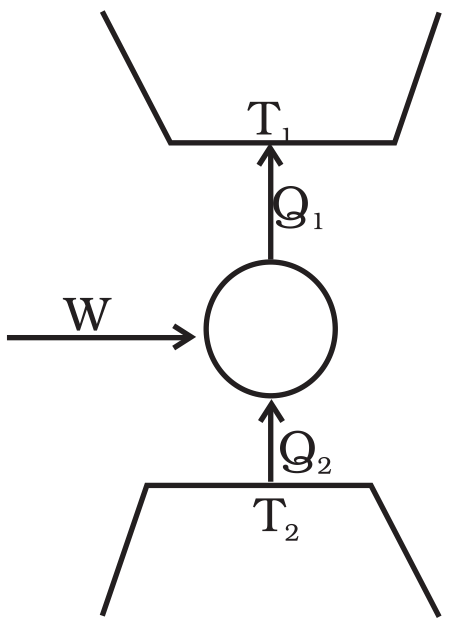
Consider a heat engine as shown in $Q_1$ and $Q_2$ are heat added to heat bath $T_1$ and heat taken from $T_2$ in one cycle of engine. W is the mechanical work done on the engine. If $W > 0,$ then possibilities are:
In $1913,$ Niels Bohr gave theory on the basis of:
The mass number of a nucleus is:
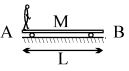
The figure shows a man of mass $m$ standing at the end $A$ of a trolley of mass $M$ placed at rest on a smooth horizontal surface. The man starts moving towards the end $B$ with a velocity $u_{rel}$ with respect to the trolley. The length of the trolley is $L$. The time taken by the man to reach the other end is
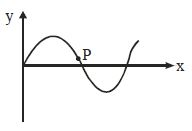
A transverse sinusoidal wave moves along a string in the positive $x-$ direction at a speed of $10\, cm/s$. The wavelength of the wave is $0.5\, m$ and its amplitude is $10\, cm$. At a prticular time $t$, the snap-shot of the wave is shown in the figure. the velocity of point $P$ when its displacement is $5\, cm$, is 
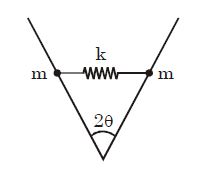
Two particles of mass $m$ are constrained to move along two horizontal frictionless rails that make an angle $2\theta $ with respect to each other. They are connected by a spring with spring constant $k$ . The angular frequency of small oscillations for the motion where the two masses always stay parallel to each other (that is the distance between the meeting point of the rails and each particle is equal) is 
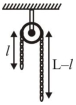
A uniform metal chain of mass $m$ and length ' $L$ ' passes over a massless and frictionless pulley. It is released from rest with a part of its length ' $l$ ' is hanging on one side and rest of its length ' $L -l$ ' is hanging on the other side of the pulley. At a certain point of time, when $l=\frac{L}{x}$, the acceleration of the chain is $\frac{g}{2}$. The value of $x$ is ........
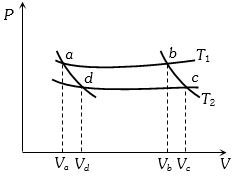
In the following $P-V$ diagram two adiabatics cut two isothermals at temperatures $T_1$ and $T_2$ (fig.). The value of $\frac{{{V_a}}}{{{V_d}}}$ will be