Question
Which one of the following elements has the highest ionisation energy
Generate a complete, print-ready paper with questions like this in minutes — across 16+ boards, with answer keys.
$(I)\, [Co(NO_2)_3(NH_3)_3]$
$(II)$ cis $-[ RhCl_2 (NH_3)_4]^+$
$(III)\, [Cr(OX)_3]^{-3}$
$(IV)$ cis $ -[PtCl_2 (en)]$
$(V)$ trans $-[Cr(en)_2 Br_2]^+$
$(VI)$ cis $-[Cr(en)_2 Br_2]^+$
When attached to $sp^3$ -hybridized carbon, their leaving group ability in nucleophilic substitution reaction decreases in the order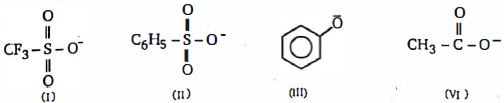
| $List-I$ | $List-II$ |
| $(A)$ $Cd ( s )+2 Ni ( OH )_{3}( s ) \rightarrow CdO ( s )+2 Ni ( OH )_{2}( s )+ H _{2} O (l)$ | $(I)$ Primary battery |
| $(B)$ $Zn ( Hg )+ HgO ( s ) \rightarrow ZnO ( s )+ Hg (l)$ | $(II)$ Discharging of secondary battery |
| $(C)$ $2 PbSO _{4}( s )+2 H _{2} O (l) \rightarrow Pb ( s )+ PbO _{2}( s )+ 2 H _{2} SO _{4}( aq )$ | $(III)$ Fuel cell |
| $(D)$ $2 H _{2}( g )+ O _{2}( g ) \quad \rightarrow 2 H _{2} O (l)$ | $(IV)$ Charging of secondary battery |
Choose the correct answer from the options given below.
Reason $R:$ The increasing nuclear charge outweighs the shielding across the period.
In the light of the above statements, choose the most appropriate from the options given below: