Question
Which one of the following have minimum wavelength

Answer

(b) cosmic Rays $10^{-14} \mathrm{m}$ to $10^{-12} \mathrm{m}$

$\gamma$ Rays $10^{-12} m$ to $10^{-10} m$

$x$ Rays $10^{-10} \mathrm{m}$ to $10^{-09} \mathrm{m}$

Ultraviolet Rays $10^{-07} \mathrm{m}$ to $4 \times 10^{-07} \mathrm{m}$

Hence, cosmic Rays have smallest wavelength.

Need a full question paper?

Generate a complete, print-ready paper with questions like this in minutes — across 16+ boards, with answer keys.

Start Generating Free

Similar questions

Which of the following shows the correct relationship between the pressure $'P'$ and density $\rho $ of an ideal gas at constant temperature ?
A particle is projected vertically upwards from $O$ with velocity $v$ and a second particle is projected at the same instant from $P$ (at a height h above $O$) with velocity $v$ at an angle of projection $\theta$ . The time when the distance between them is minimum is
Assertion : The air bubble shines in water.

Reason : Air bubble in water shines due to refraction of light.
A modulating signal $2 \sin \left(6.28 \times 10^{6}\right) t$ is added to the carrier signal $4 \sin \left(12.56 \times 10^{9}\right)$ t for amplitude modulation. The combined signal is passed through a non-linear square law device. The output is then passed through a band pass filter. The bandwidth of the output signal of band pass filter will be $MHz$.
An electron is moving with a speed of ${10^8}\,m/\sec $ perpendicular to a uniform magnetic field of intensity $B$. Suddenly intensity of the magnetic field is reduced to $B/2$. The radius of the path becomes from the original value of $r$
The coefficient of volumetric expansion of mercury is $18 × 10^{-5}{°C^{-1}}$. A thermometer bulb has a volume $10^{-6}\, m^3$ and cross section of stem is $ 0.004 \,cm^2$. Assuming that bulb is filled with mercury at $0°C$ then the length of the mercury column at $100°C$ is
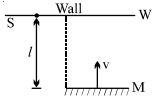
$A$ flat mirror $M$ is arranged parallel to a wall $W$ at a distance $l$ from it. The light produced by a point source $S$ kept on the wall is reflected by the mirror and produces a light spot on the wall. The mirror moves with velocity $v$ towards the wall.
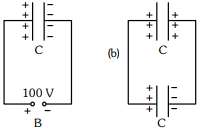
A capacitor of capacitance $C =900\,pF$ is charged fully by $100\,V$ battery $B$ as shown in figure $(a)$. Then it is disconnected from the battery and connected to another uncharged capacitor of capacitance $C =900\,pF$ as shown in figure $(b)$. The electrostatic energy stored by the system $(b)$ is $\dots\dots\times 10^{-6}\,J$
An object is placed at a distance of $4\,cm$ in front of a concave lens of focal length $12\,cm$ . The nature and position of the image from the lens is
Four equal positive charges are fixed at the vertices of a square of side $L$. $Z$-axis is perpendicular to the plane of the square. The point $z = 0$ is the point where the diagonals of the square intersect each other. The plot of electric field due to the four charges, as one moves on the $z-$ axis.