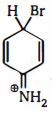
MCQ
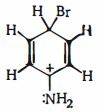
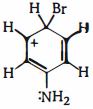
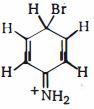
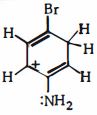
Which one of the following is most stable ?
  • A

  • B


  • D

Answer

Correct option: C.

c
Most stable $R.S.$ because cation has complete octet

Need a full question paper?

Generate a complete, print-ready paper with questions like this in minutes — across 16+ boards, with answer keys.

Start Generating Free

Similar questions

Among $\mathrm{H}_2, \mathrm{He}_2^{+}, \mathrm{Li}_2, \mathrm{Be}_2, \mathrm{~B}_2, \mathrm{C}_2, \mathrm{~N}_2, \mathrm{O}_2^{-}$, and $\mathrm{F}_2$, the number of diamagnetic species is (Atomic numbers: $\mathrm{H}=1, \mathrm{He}=2, \mathrm{Li}=3, \mathrm{Be}=4, \mathrm{~B}=5, \mathrm{C}=6, \mathrm{~N}=7, \mathrm{O}=8, \mathrm{~F}=9$ )
Which pair of elements with the given atomic numbers is expected to have similar properties?
Given below are two statements: One is labelled as Assertion ($A$) and the other is labelled as Reason ($R$)

Assertion ($A$): Enthalpy of neutralisation of strong monobasic acid with strong monoacidic base is always $-57 \mathrm{~kJ} \mathrm{~mol}^{-1}$

Reason ($R$): Enthalpy of neutralisation is the amount of heat liberated when one mole of $\mathrm{H}^{+}$ions furnished by acid combine with one mole of ${ }^{-} \mathrm{OH}$ ions furnished by base to form one mole of water. In the light of the above statements, choose the correct answer from the options given below.

$ $
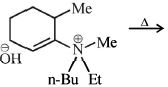
The alkene formed as a major product in the below elimination reaction is
$9.0\, gm$  of ${H_2}O$ is vaporised at ${100\,^o}C$ and  $1 \,atm$  pressure. If the latent heat of vaporisation of water is $x\,J/gm$, then $\Delta S$ is given by
Rate of $S_{N^{2}}$ reactions depends on :
The second ionization potential of elements is invariable higher than first ionization  potential because
For the following Assertion and Reason, the correct option is

Assertion : The $pH$ of water increases with increase in temperature.

Reason : The dissociation of water into $H^+$ and $OH^-$ is an exothermic reaction.

Which of the comparison regarding $Zn,\,Cd,\,Hg$ is/are incorrect ?

$(I)$ $ZnCl_2$ is ionic whereas $CdCl_2$ and $HgCl_2$ are covalent

$(II)$ $Zn$ and $Cd$ dissolves in dilute acid $(HCl)$ liberating $H_2$ but $Hg$ can not

$(III)$ $Zn$ and $Cd$ forming with ppt. of $Zn(OH)_2$ and $Cd(OH)_2$ but $Hg$ forms coloured ppt. of

$(IV)$ all from $A_2^{2+}$ type ion