MCQ
Which one of the following is not correct :
  • A
    Dipole moment : $H_2O_2 > H_2O > NH_3 > SF_6$
  • B
    Bond angle : $N_3^-> \mathop N\limits^ \bullet  {O_2} > \mathop C\limits^ \bullet  {F_3}$
  • C
    Bond order : $O_2^{2+} > O_2 > O_2^{2-}$
  • $(N-N)$ Bond length : $N_3^-> N_2H_4 > N_2$

Answer

Correct option: D.
$(N-N)$ Bond length : $N_3^-> N_2H_4 > N_2$
d

Need a full question paper?

Generate a complete, print-ready paper with questions like this in minutes — across 16+ boards, with answer keys.

Start Generating Free

Similar questions

Among the species given below, the total number of diamagnetic species is. . . . .$\mathrm{H}$ atom, $\mathrm{NO}_2$ monomer, $\mathrm{O}_2^{-}$(superoxide), dimeric sulphur in vapour phase, $\mathrm{MnsO}_4$, $\left(\mathrm{NH}_4\right)_2\left[\mathrm{FeCl}_4\right],\left(\mathrm{NH}_4\right)_2\left[\mathrm{NiCl}_4\right], \mathrm{K}_2 \mathrm{MnO}_4, \mathrm{~K}_2 \mathrm{CrO}_4$
How many geometrical isomers are possible for $[Pd^{2+} (NH_2 -CH(CH_3 )-CO^-_2)_2]$
Which of the following is the strongest Bronsted acid ?
The $IUPAC$ name of the given compound is
Number of compounds which give reaction with Hinsberg's reagent is____.
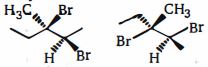
How are the following compounds related ?
For the complex $ML_2$, stepwise formation constants 

                                  $M + L \rightleftharpoons ML$

                                  $ML + L \rightleftharpoons M{L_2}$

are $4$ and $3$. Hence, overall stability constant for

                                   $M + 2L \rightleftharpoons M{L_2}$ is

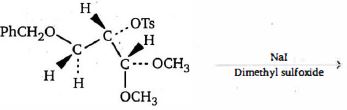
Major product which you expect in the above reaction is
Complete removal of both the axial ligands (along the $z-$ axis) from an octahedral complex leads to which of the following splitting patterns? (relative orbital energies not on scale)
What is the freezing point depression constant of a solvent, 50 g of which contain 1 g non volatile solute (molar mass $256 \mathrm{~g} \mathrm{~mol}^{-1}$ ) and the decrease in freezing point is 0.40 K ?