MCQ
Which one of the following molecules is paramagnetic?
- A$N_2$
- B$NO$
- ✓$CO$
- D$O_3$
Total no. of electrons in $NO$
$=7(N)+8(O)=15$
Hence $E.C.$ of $NO$
$KK{[\sigma 2s]^2}{[{\sigma ^*}(2s)]^2}{[\sigma 2{p_z}]^2}$
${[\pi (2{p_x})]^2}[\pi {(2{p_y})^2}]{[{\pi ^*}(2{p_x})]^1}$
Due to presence of one unpaired electron
$NO$ is paramagnetic.
Except $NO$ all are diamagnetic dur to absence of unpaired electrons.
Generate a complete, print-ready paper with questions like this in minutes — across 16+ boards, with answer keys.
Set $1$: $Al_2O_3 .xH_2O\, (s)$ and $OH^-(aq)$
Set $2$: $Al_2O_3 .xH_2O\, (s)$ and $H_2O\,(l)$
Set $3$: $Al_2O_3 .xH_2O\, (s)$ and $H^+(aq)$
Set $4$: $Al_2O_3 .xH_2O\, (s)$ and $NH_3(aq)$
$\begin{array}{*{20}{c}}
{C{H_3}CH = C{H_2} + {H_2}O\overset {{H^ + }} \longleftrightarrow C{H_3} - CH - C{H_3}} \\
{\,\,\,\,\,\,\,\,\,\,\,\,\,\,\,\,\,\,\,\,\,\,\,\,\,\,\,\,\,\,\,\,\,\,\,\,\,\,\,\,\,\,\,\,\,\,\,\,\,\,\,\,\,\,\,\,\,\,\,\,\,\,\,\,\,\,\,\,\,|} \\
{\,\,\,\,\,\,\,\,\,\,\,\,\,\,\,\,\,\,\,\,\,\,\,\,\,\,\,\,\,\,\,\,\,\,\,\,\,\,\,\,\,\,\,\,\,\,\,\,\,\,\,\,\,\,\,\,\,\,\,\,\,\,\,\,\,\,\,\,\,\,\,\,\,\,\,OH}
\end{array}$
The reaction takes place in accordance with
$X$ and $Y$ respectively are :-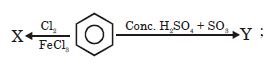
| Period number | Group number | |
| $P$ | $2$ | $15$ |
| $Q$ | $3$ | $2$ |
Then formula of the compound formed by $P$ and $Q$ element is
[Given $: R =8.31 \,J \,K ^{-1} \,mol ^{-1}, \log 1.33=0.1239$ $\ln 10=2.3]$