Which one of the following on reduction with lithium aluminium hydride yields a secondary amine?
AIPMT 2007, Medium


Download our appand get started for free
Experience the future of education. Simply download our apps or reach out to us for more information. Let's shape the future of learning together!No signup needed.*
Similar Questions
- 1View SolutionAn organic compound on reaction with Nitrous acid give alcohol. Then the organic compound can be
- 2View SolutionThe alkyl cyanides when hydrolysed to the corresponding acid, the gas evolved is
- 3Which is the best method for preparation of the $N$ -methyl ethanamide?View Solution
- 4The product($s$) of the following reaction sequence is(are)View Solution
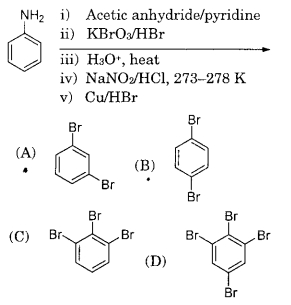
- 5View SolutionThe major product of the above reaction is ...... .

- 6View SolutionThe arenium ion which is not involved in the bromination of Aniline is .
- 7$(i)$ chlorobenzene is mono-nitrated to $M$View Solution
$(ii)$ nitrobenezene is mono-chlorinated to $N$
$(iii)$ anisole is mono-nitrated to $P$
$(iv)\, 2-$ nitrochlorobenzene is mono-nitrated to $Q.$
Out of $M, N, P$ and $Q$ the compound that undergoes reaction with $aq. NaOH$ fastest is - 8A compound having molecular formula $C_3H_6O$ , on reaction with $\begin{array}{*{20}{c}}View Solution
{\,\,\,\,\,\,\,\,\,\,\,\,\,\,\,\,\,\,O} \\
{\,\,\,\,\,\,\,\,\,\,\,\,\,\,\,\,\,||} \\
{N{H_2} - NH - C - N{H_2}}
\end{array}$ produces mainly $P$ (shows stereoisomerism) which on reaction with $KOH /$ ethylene glycol, $\Delta$ produces propane then $(P)$ is - 9From $6.55 \mathrm{~g}$ of aniline, the maximum amount of acetanilide that can be prepared will be _ $\times 10^{-1} \mathrm{~g}$.View Solution
- 10The most appropriate reagent for conversion of $C _{2} H _{5} CN$ into $CH _{3} CH _{2} CH _{2} NH _{2}$ isView Solution