MCQ
Which one of the following statement is true for transition elements
- AThey exhibit diamagnetism
- BThey exhibit inert pair effect
- CThey do not form alloys
- ✓They show variable oxidation states
Generate a complete, print-ready paper with questions like this in minutes — across 16+ boards, with answer keys.
$\begin{align}
\begin{matrix}
O\,\,\,\,\,\,\,\,\,\,\,\,\,\,\,\,\,\,\,\,\,\,\,\,\,\,\,\,\,\,\,\,\,\,\,\,\,\,\,\,\,\,\,\,\,\,\,\,\,\,\,\,\, \\
||\,\,\,\,\,\,\,\,\,\,\,\,\,\,\,\,\,\,\,\,\,\,\,\,\,\,\,\,\,\,\,\,\,\,\,\,\,\,\,\,\,\,\,\,\,\,\,\,\,\,\,\,\, \\
H-O-C-C{{H}_{2}}-C{{H}_{2}}-CH-C{{O}_{2}}H \\
\,\,\,\,\,\,\,\,\,\,\,\,\,\,\,\,\,\,\,\,\,\,\,\,\,\,\,\,\,\,\,\,\,\,\,\,\,\,\,\,\,\,\,\,\,\,\,| \\
\,\,\,\,\,\,\,\,\,\,\,\,\,\,\,\,\,\,\,\,\,\,\,\,\,\,\,\,\,\,\,\,\,\,\,\,\,\,\,\,\,\,\,\,\,\,\,\,\,\,\,\,\,\underset{\oplus }{\mathop{N}}\,{{H}_{3}} \\
\end{matrix}\,\,\,\,\,(p{{K}_{a}}=2) \\
(p{{K}_{a}}=4)\,\,\,\,\,\,\,\,\,\,\,\,\,\,\,\,\,\,\,\,\,\,\,\,\,\,\,\,\,\,\,\,\,\,\,\,\,\,\,\,\,\,\,\,(p{{K}_{a}}=9) \\
\end{align}$
Statement $(I)$: A solution of $\left[\mathrm{Ni}\left(\mathrm{H}_2 \mathrm{O}\right)_6\right]^{2+}$ is green in colour.
Statement $(II)$: A solution of $\left[\mathrm{Ni}(\mathrm{CN})_4\right]^{2-}$ is colourless.
In the light of the above statements, choose the most appropriate answer from the options given below:
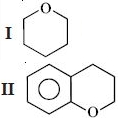
Which forms di-iodide on reaction with $HI $ (excess) ?