MCQ
Which one of the following statements is not true about the motion of a projectile?
  • A
    The time of flight of a projectile is proportional to the speed with which it is projected at a given angle of projection
  • The horizontal range of a projectile is proportional to the square root of the speed with which it is projected
  • C
    For a given speed of projection, the angle of projection for maximum range is $45^{\circ}$
  • D
    At maximum height, the acceleration due to gravity is perpendicular to the velocity of the projectile
Answer

Correct option: B.
The horizontal range of a projectile is proportional to the square root of the speed with which it is projected
b
(b)

$R=\frac{u^2 \sin 2 \theta}{g} \Rightarrow R \propto u^2$

Need a full question paper?

Generate a complete, print-ready paper with questions like this in minutes — across 16+ boards, with answer keys.

Start Generating Free

Similar questions

An air column in a pipe, which is closed at one end, will be in resonance wtih a vibrating tuning fork of frequency $264\, Hz$ if the length of the column in $cm$ is (velocity of sound $= 330\, m/s$)
An object is projected upwards with a velocity of $100 \,m/s$. It will strike the ground after (approximately)........$sec$
A particle is moving such that its position coordinates $(x, y)$  are

$(2\, m, 3 \,m)$ at time $t = 0$

$(6\,m,7\,m) ,$ at time $ t=2 \,s$ and

$ (13\,m,14\,m),$ at $ t=5\,s$.

Average velocity vector $\vec v_{av}$ from $ t=0$ to $t= 5 $ is

A simple pendulum is vibrating in an evacuated chamber, it will oscillate with
A bullet $10\,g$ leaves the barrel of gun with a velocity of $600\,m / s$. If the barrel of gun is $50\,cm$ long and mass of gun is $3\,kg$, then value of impulse supplied to the gun will be $.....\,Ns$
A car is moving with velocity $V$. If stop after applying break at a distance of $20\; m$. If velocity of car is doubled, then how much distance it will cover (travel) after applying break
The amount of heat energy required to raise the temperature of $1\, g$ of Helium at  $NTP,$ from $T_1 K$ to $T_2 K$ is 
A particle of mass $M$ originally at rest is subjected to a force whose direction is constant but magnitude varies with time according to the relation

$F=F_{0}\left(1-\left(\frac{t-T}{T}\right)^{2}\right)$

Where $F_{0}$ and $T$ are constants. The force acts only for the time internal $2 T$. The velocity $v$ of the particle after time $2 {T}$ is -

Three forces are acting simultaneously at one point. Two forces $\overrightarrow{ P }, \overrightarrow{ Q }$ are $(2 \hat{i}-3 \hat{j})$ and $(\hat{i}-\hat{j})$ respectively. If the object is in equilibrium then which will be the third:
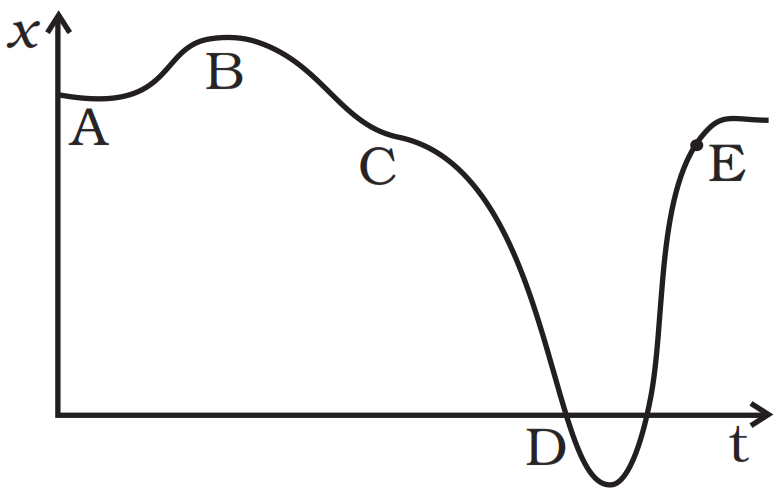
A graph of $x$ versus $t$ is shown in Fig. Choose correct alternatives from below: