MCQ
Which one of the following statements is not true about the motion of a projectile?
  • A
    The time of flight of a projectile is proportional to the speed with which it is projected at a given angle of projection
  • The horizontal range of a projectile is proportional to the square root of the speed with which it is projected
  • C
    For a given speed of projection, the angle of projection for maximum range is $45^{\circ}$
  • D
    At maximum height, the acceleration due to gravity is perpendicular to the velocity of the projectile
Answer

Correct option: B.
The horizontal range of a projectile is proportional to the square root of the speed with which it is projected
b
(b)

$R=\frac{u^2 \sin 2 \theta}{g} \Rightarrow R \propto u^2$

Need a full question paper?

Generate a complete, print-ready paper with questions like this in minutes — across 16+ boards, with answer keys.

Start Generating Free

Similar questions

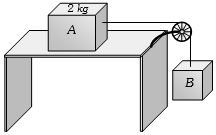
The coefficient of static friction, ${\mu _s},$ between block $A$ of mass $2\, kg$ and the table as shown in the figure is $0.2$. ........ $kg$ would be the maximum mass value of block $B$ so that the two blocks do not move. The string and the pulley are assumed to be smooth and massless. $(g = 10\,m/{s^2})$
In the $HCl$ molecule, the separation between the nuclei of the two atoms is about $1.27\ Å $.  The approximate location of the centre of mass of the molecule from hydrogen is . ....... $\mathop A\limits^o $. (assuming the chlorine atom to be about $35.5$ times massive as hydrogen)
A particle moves along a straight line as $s = u(t - 2) + a(t - 2)^2$
An aluminium rod having a length $100 \,cm$ is clamped at its middle point and set into longitudinal vibrations. Let the rod vibrate in its fundamental mode. The density of aluminium is $2600 \,kg / m ^3$ and its Young's modulus is $7.8 \times 10^{10} \,N / m ^2$. The frequency of the sound produced is .............. $Hz$
A simple harmonic oscillator has a period of $0.01 \,sec$ and an amplitude of $0.2\, m$. The magnitude of the velocity in $m{\sec ^{ - 1}}$ at the centre of oscillation is
It is found that if a neutron suffers an elastic collinear collision with deuterium at rest, fractional loss of its energy is $p_d $ ; while for its similar collision with carbon nucleus at rest, fractional loss of energy is $P_c$. The values of $P_d$ and $P_c$ are respectively
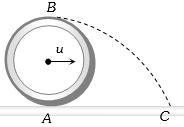
A wheel of radius $r$ rolls without slipping with a speed $v$ on a horizontal road. When it is at a point $A$ on the road, a small jump of mud separates from the wheel at its highest point $B$ and drops at point $C$ on the road. The distance $AC$ will be
Heat required to convert $5\ kg$ ice at $0\ ^oC$ into water at $100\ ^oC$ is
A bomb of mass $16\ kg$ at rest explodes into two pieces of masses $4\ kg$ and $12\ kg.$ The velolcity of the $12\ kg$ mass is $4$ $ms^{-1}$. The kinetic energy of the other mass is .............. $\mathrm{J}$
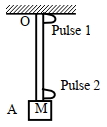
A block $\mathrm{M}$ hangs vertically at the bottom end of a uniform rope of constant mass per unit length. The top end of the rope is attached to a fixed rigid support at $O$. A transverse wave pulse (Pulse $1$ ) of wavelength $\lambda_0$ is produced at point $O$ on the rope. The pulse takes time $T_{O A}$ to reach point $A$. If the wave pulse of wavelength $\lambda_0$ is produced at point $A$ (Pulse $2$) without disturbing the position of $M$ it takes time $T_{A 0}$ to reach point $O$. Which of the following options is/are correct?

(image)

[$A$] The time $\mathrm{T}_{A 0}=\mathrm{T}_{\mathrm{OA}}$

[$B$] The velocities of the two pulses (Pulse $1$ and Pulse $2$) are the same at the midpoint of rope.

[$C$] The wavelength of Pulse $1$ becomes longer when it reaches point $A$.

[$D$] The velocity of any pulse along the rope is independent of its frequency and wavelength.