MCQ
Which one of these is non-divisible
  • A
    Nucleus
  • Photon
  • C
    Proton
  • D
    Atom

Answer

Correct option: B.
Photon
 Photon

Need a full question paper?

Generate a complete, print-ready paper with questions like this in minutes — across 16+ boards, with answer keys.

Start Generating Free

Similar questions

A plot of the number of neutrons $(N)$ against the number of protons ( $P$ )of stable nuclei exhibits upward deviation from linearity for atomic number, $Z>20$. For an unstable nucleus having $N / P$ ratio less than $1$ , the possible mode($s$) of decay is(are)

($A$) $\beta^{-}$-decay ( $\beta$ emission)

($B$) orbital or $K$-electron sasture

($C$) neutron emission

($D$) $\beta^{+}$-decay (positron emission)
A gamma ray photon creates an electron- positron pair. If the rest mass energy of an electron is $0.5\, MeV$ and the total $K.E.$ of the electron- positron pair is $0.78\, MeV$, then the energy of the gamma ray photon must be.......$MeV$
Two concentric circular coils of ten turns each are situated in the same plane. Their radii are 20 and 40 cm and they carry respectively 0.2 and 0.3 ampere current in opposite direction. The magnetic field in weber/m$^2$ at the centre is
An electron enters in high potential region ${V_2}$ from lower potential region ${V_1}$ then its velocity
According to Joule's law, if the potential difference across a conductor having a material of specific resistance remains constant, then the heat produced in the conductor is directly proportional to
An atom of mass number 15 and atomic number 7 captures an α - particle and then emits a proton. The mass number and atomic number of the resulting product will respectively be
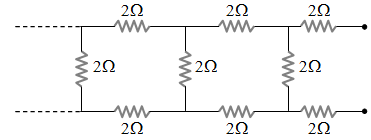
The equivalent resistance of the following infinite network of resistances is

50% of the X-ray coming from a Coolidge tube is able to pass through a 0.1mm thick aluminium foil. The potential difference between the target and the filament is increased. The thickness of the aluminium foil that will allow 50% of the X-ray to pass through will be:
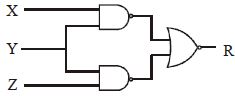
Figure shows $2 NAND$ gates followed by a $NOR$ gate. The system is equivalent to one gate $G$ with inputs $X, Y, Z$ and output $R$. What is $G$ ?
A thin prism $P_1$ with an angle $6^{\circ}$ and made of glass of refractive index $1.54$ is combined with another prism $P _2$ made from glass of refractive index $1.72$ to produce dispersion without average deviation. The angle of prism $P_2$ is $........{}^{\circ}$