MCQ
Which one pair of atoms or ions will have same configuration
  • A
    ${F^ + }$ and $Ne$
  • B
    $L{i^ + }$ and $H{e^ - }$
  • $C{l^ - }$ and $Ar$
  • D
    $Na$ and $ K$

Answer

Correct option: C.
$C{l^ - }$ and $Ar$
c
(c) No. of electron are same $(18)$  in $C{l^ - }$ and $Ar$.

Need a full question paper?

Generate a complete, print-ready paper with questions like this in minutes — across 16+ boards, with answer keys.

Start Generating Free

Similar questions

Product $(P)$ of the reaction is
Total number of stereo isomers of $[Co( acac)_2BrCl)^{\ominus}$ are
Assign $A, B, C, D$ from given type of reaction. ${H_3}P{O_2} + CuS{O_4} \longrightarrow Cu \downarrow  + {H_3}P{O_4} + HN{O_3}$
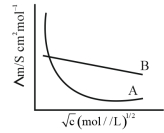
Following figure shows dependence of molar conductance of two electrolytes on concentration. $\Lambda \stackrel{0}{ m }$ is the limiting molar conductivity.The number of Incorrect statement(s) from the following is $...........$

$(A)$ $\Lambda \stackrel{0}{ m }$ for electrolyte $A$ is obtained by extrapolation

$(B)$ For electrolyte B, vx $\Lambda m$ vs $\sqrt{ c }$ graph is a straight line with intercept equal to $\Lambda \stackrel{0}{ m }$

$(C)$ At infinite dilution, the value of degree of dissociation approach zero for electrolyte $B$.

$(D)$ $\Lambda \stackrel{0}{ m }$ for any electrolyte $A$ or $B$ can be calculated using $\lambda^{\circ}$ for individual ions.
Assertion : The kinetics of the reaction -

$mA + nB + pC \to m' X + n 'Y + p 'Z$

obey the rate expression as $\frac{{dX}}{{dt}} = k{[A]^m}{[B]^n}$.

Reason : The rate of the reaction does not depend upon the concentration of $C$.

An element, $X$ has the following isotopic composition :

$^{200}X \,:\, 90\%$       $^{199}X\, :\, 8.0\%$       $^{202}X\, :\, 2.0\%$

The weighted average atomic mass of the naturally occurring element $X$ is closest to......$amu$
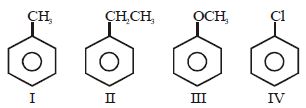
Arrange the following compounds in their correct order of reactivity towards electrophilic substitution reaction
$C{H_3} - C \equiv C - C{H_3}\,\xrightarrow[{{\text{(2) B}}{{\text{r}}_2}}]{{{\text{(1)}}{{\text{H}}_2}{\text{ /Pd/CaC}}{{\text{O}}_3}}}\,(X){\kern 1pt} ,\,(X)$  is
Benzyne intermediate is not observed in :
An element has successive ionization enthalpies as $940\, (first), 2080, 3090, 4140, 703 0, 7870,16000$ and $19500\, kJ \,mol^{-1}.$ To which group of the periodic table does  this element belong?