MCQ
Which one the following compounds will readily react with dilute $\mathrm{NaOH}$ ?
  • A
    $\mathrm{C}_6 \mathrm{H}_5 \mathrm{CH}_2 \mathrm{OH}$
  • B
    $\mathrm{C}_2 \mathrm{H}_5 \mathrm{OH}$
  • C
    $\left(\mathrm{CH}_3\right)_3 \mathrm{COH}$
  • $\mathrm{C}_6 \mathrm{H}_5 \mathrm{OH}$
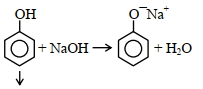
Answer

Correct option: D.
$\mathrm{C}_6 \mathrm{H}_5 \mathrm{OH}$
d
Stronger $ACID$ than $\mathrm{H}_2 \mathrm{O}$

Need a full question paper?

Generate a complete, print-ready paper with questions like this in minutes — across 16+ boards, with answer keys.

Start Generating Free

Similar questions

A nitrogen containing organic compound gave an oily liquid on heating with bromine and potassium hydroxide solution. On shaking the product with acetic anhydride, an antipyretic drug was obtained. The reactions indicate that the starting compound is
The $I U P A C$ name of the complex $\left[P t\left(N H_{3}\right)_{3} B r\left(N O_{2}\right) C l\right] C l$ is
The correct statement$(s)$ regarding, $(i)$ $HC1O$, $(ii)$ $HClO _2$, $(iii)$ $HClO _3$ and $(iv)$ $HClO _4$, is (are)

$(A)$ The number of $Cl = O$ bonds in $(ii)$ and $(iii)$ together is two

$(B)$ The number of lone pairs of electrons on $Cl$ in $(ii)$ and $(iii)$ together is three

$(C)$ The hybridization of $Cl$ in $(iv)$ is $sp ^3$

$(D)$ Amongst $(i)$ to $(iv)$, the strongest acid is $(i)$

The term 'feed back' refers to the effect of:
Destructive distillation of wood in the laboratory will result in the formation of:
Molar conductivity $\left(\Lambda_m\right)$ of aqueous solution of sodium stearate, which behaves as a strong electrolyte, is recorded at varying concentration($c$) of sodium stearate. Which one of the following plots provides the correct representation of micelle formation in the solution?

(Critical micelle concentration ($CMC$) is marked with an arrow in the figures.)

$B.H.C.$  is used as
$TNT$ has the structure
From the compounds given below, number of compounds which give positive Fehling's test is..................

Benzaldehyde, Acetaldehyde, Acetone,  Acetophenone,Methanal, $4-$nitrobenzaldehyde, cyclohexane carbaldehyde.

Glacial acetic is obtained by