MCQ
Which optically active compound on reduction with $LiAlH_4$ will give optically inactive compound ?
  • A
    $\begin{array}{*{20}{c}}
      {C{H_3} - CH - COOH} \\ 
      {|\,\,\,\,\,\,\,\,\,\,\,\,\,\,} \\ 
      \,\,{OC{H_3}} 
    \end{array}$
  • B
    $\begin{array}{*{20}{c}}
      {C{H_3} - C{H_2} - CH - COOH} \\ 
      {\,\,\,\,\,\,|} \\ 
      {\,\,\,\,\,\,\,\,\,\,\,\,\,\,OH} 
    \end{array}$
  • $\begin{array}{*{20}{c}}
      {C{H_3} - C{H_2} - CH - COOH} \\ 
      {\,\,\,\,\,|} \\ 
      {\,\,\,\,\,\,\,\,\,\,\,\,\,\,\,\,\,\,\,\,\,\,\,C{H_2}OH} 
    \end{array}$
  • D
    $\begin{array}{*{20}{c}}
      {C{H_3} - CH - C{H_2} - COOH} \\ 
      {|\,\,\,\,\,\,\,\,\,\,\,\,\,\,\,\,\,\,\,\,\,\,\,\,\,\,\,\,\,\,\,\,\,} \\ 
      {OH\,\,\,\,\,\,\,\,\,\,\,\,\,\,\,\,\,\,\,\,\,\,\,\,\,\,\,} 
    \end{array}$
Answer

Correct option: C.
$\begin{array}{*{20}{c}}
  {C{H_3} - C{H_2} - CH - COOH} \\ 
  {\,\,\,\,\,|} \\ 
  {\,\,\,\,\,\,\,\,\,\,\,\,\,\,\,\,\,\,\,\,\,\,\,C{H_2}OH} 
\end{array}$
c

Need a full question paper?

Generate a complete, print-ready paper with questions like this in minutes — across 16+ boards, with answer keys.

Start Generating Free

Similar questions

Which compound will not undergo decarboxylation on heating ?
Arrange the following solutions in order of decreasing freezing points

$(a)\,0.075\,\,M\,CuS{O_4}$                 $(b)\,0.060\,\,M\,(NH_4)_2SO_4$

$(c)\,0.14\,\,M\,urea$                         $(d)\,0.04\,M\,MgCl_2$

Generally transition elements form coloured salts due to the presence of unpaired electrons. Which of the following compounds will be coloured in solid state?
Which of the following is an example of absorption?
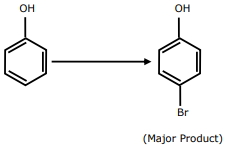
Electrophilic substitution reaction in phenol takes place at:
The number of unpaired electrons in cobalt atom is (atomic number of $Co = 27$)
The given reaction can occur in the presence of:

$(1)$ Bromine water        $(2)$ $\mathrm{Br}_{2}$ in $\mathrm{CS}_{2}, 273 \mathrm{~K}$       $(3)$ $\mathrm{Br}_{2} / \mathrm{FeBr}_{3}$    $(4)$ $\mathrm{Br}_{2}$ in $\mathrm{CHCl}_{3}, 273 \,\mathrm{~K}$

Choose the correct answer from the options given below:

Arrange these esters in decreasing order of case of esterfication with $C{H_3}OH/{H^ \oplus }$ :

$(I)$ $\begin{array}{*{20}{c}}
  {C{H_3} - CH - COOH} \\ 
  {|\,\,\,\,\,\,\,\,\,\,\,\,\,\,} \\ 
  {C{H_3}\,\,\,\,\,\,\,} 
\end{array}$

$(II)$  $\begin{array}{*{20}{c}}
  {C{H_3} - CH - C{H_2} - COOH} \\ 
  {|\,\,\,\,\,\,\,\,\,\,\,\,\,\,\,\,\,\,\,\,\,\,\,\,\,\,\,\,\,\,} \\ 
  {C{H_3}\,\,\,\,\,\,\,\,\,\,\,\,\,\,\,\,\,\,\,\,\,\,} 
\end{array}$

$(III)$ $\begin{array}{*{20}{c}}
  \,\,{C{H_3}} \\ 
  {|\,\,\,\,\,\,\,\,} \\ 
  {C{H_3} - C - COOH} \\ 
  {|\,\,\,\,\,\,} \\ 
  \,\,{C{H_3}\,} 
\end{array}$

$(IV)$ $(CH_3-CH_2)_3C-COOH$

A $4$ ampere is passed through a solution of zinc sulphate for $50\, minutes$. Find the amount of zinc deposited at the cathode ............. $\mathrm{g}$
An aqueous solution of glucose was prepared by dissolving  $18\,g$ of glucose in $90\,g$ of water. The relative lowering in vapour pressure is