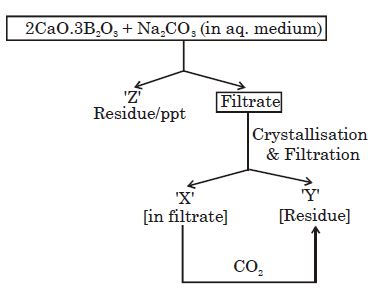
MCQ
Which oxide is alkaline
- A${P_2}{O_3}$
- ✓$B{i_2}{O_3}$
- C$A{s_2}{O_3}$
- D${B_2}{O_3}$
Generate a complete, print-ready paper with questions like this in minutes — across 16+ boards, with answer keys.
${H_2}C = CH - CH = C{H_2}\xrightarrow[{0{\,^o}C}]{{HBr}}$ $\begin{array}{*{20}{c}}
{{H_2}C = CH - CH - C{H_3}} \\
{\,\,\,\,\,\,\,\,\,\,\,|} \\
{\,\,\,\,\,\,\,\,\,\,\,\,\,\,\,\,\,\,\,Br\,\,\,\,\,\,}
\end{array}\xrightarrow{{ + 25{\,^o}C}}$ $\begin{array}{*{20}{c}}
{C{H_2}CH = CHC{H_3}} \\
{|\,\,\,\,\,\,\,\,\,\,\,\,\,\,\,\,\,\,\,\,\,\,\,\,\,\,\,\,\,\,\,\,\,\,\,\,\,\,\,} \\
{Br\,\,\,\,\,\,\,\,\,\,\,\,\,\,\,\,\,\,\,\,\,\,\,\,\,\,\,\,\,\,\,\,\,\,\,\,}
\end{array}$
These provide an example of $......1......$ control at low temperature and $......2......$ control at higher temperature
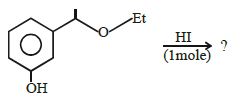
Compound $X$ and $Y$ are respectively.