MCQ
Which pair represents chain isomer
- A$C{H_3}CHC{l_2}$ and $ClC{H_2}C{H_2}Cl$
- B$n-$propyl alcohol and isopropyl alcohol
- C$2-$methyl$-1$ propanol and $2-$Methyl$-2$ propanol
- ✓$2-$methyl butane and neopentane
$2$-methyl butane
$\begin{matrix} C{{H}_{3}} \\ | \\ C{{H}_{3}}-C-C{{H}_{3}} \\ | \\ C{{H}_{3}} \\ \end{matrix}$
neo pentane
Since, they have same molecular formula but they differ in branching. So they are chain isomer.
Generate a complete, print-ready paper with questions like this in minutes — across 16+ boards, with answer keys.
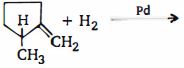
A for disproportionation reaction.
B for comproportionation reaction.
C for either intermolecular redox reaction or displacement reaction.
D for either thermal combination redox reaction or thermal decomposition redox reaction.
$MnO_4^ - + {H^ + } + B{r^ - } \longrightarrow M{n^{2 + }}\left( {aq.} \right) + B{r_2} \uparrow $
$(A)$ Freezing of water to ice at $0^{\circ} C$
$(B)$ Freezing of water to ice at $-10^{\circ} C$
$(C)$ $N _{2}( g )+3 H _{2}( g ) \rightarrow 2 NH _{3}( g )$
$(D)$ Adsorption of $CO ( g )$ and lead surface
$(E)$ Dissolution of $NaCl$ in water
Statement $I:$ Upon heating a borax bead dipped in cupric sulphate in a luminous flame, the colour of the bead becomes green.
Statement $II:$ The green colour observed is due to the formation of copper(I) metaborate.
In the light of the above statements, choose the most appropriate answer from the options given below :