Question
Which principle suggests that the intensity of light determines its amplitude?

Answer

  1. Classic wave theory
Explanation:
The principle is the classic wave theory. The classic wave theory states that the intensity of light determines the amplitude of the wave. Therefore, a greater intensity of light will cause the electrons on the metal to oscillate more violently and also to be ejected with greater kinetic energy.

Need a full question paper?

Generate a complete, print-ready paper with questions like this in minutes — across 16+ boards, with answer keys.
Start Generating Free

Similar questions

Which one of the following is true in photoelectric emission(a) Photoelectric current is directly proportional to the amplitude of light of a given frequency(b) Photoelectric current is directly proportional to the intensity of light of a given frequency at moderate intensities(c) Above the threshold frequency, the maximum K.E. of photoelectrons is inversely proportional to the frequency of incident light(d) The threshold frequency depends upon the wavelength of incident light


Photo-electric effect can be explained by(a) Corpusular theory of light(b) Wave nature of light(c) Bohr’s theory(d) Quantum theory of light
   
   
Which one of the following properties of an element is not variable?
In what order should three capacitors be connected so that the energy stored in them at the same potential is maximum?
X-rays are not used for radar purpose because(a) They are not reflected by the target(b) They are not electromagnetic waves(c) They are completely absorbed by the air(d) They sometimes damage the target


A very small magnet is placed in the magnetic meridian with its south pole pointing north. The null point is obtained $20 \ cm$ away from the centre of the magnet. If the earth's magnetic field $($horizontal component$)$ at this point be $0.3$ gauss, the magnetic moment of the magnet is
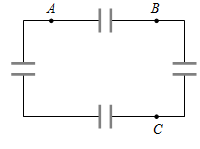
Four capacitors of each of capacity $3\ \mu F$ are connected as shown in the adjoining figure. The ratio of equivalent capacitance between $A$ and $B$ and between $A$ and $C$ will be
A radioactive material decays by simultaneous emission of two particles with respective half lives 1620 and 810 years. The time (in years) after which one- fourth of the material remains is (a) 1080  (b) 2430(c) 3240  (d) 4860
       
A dry cell has an e.m.f. of 1.5 V and an internal resistance of 0.05Ω. The maximum current obtainable from this cell for a very short time interval is(a) 30 A(b) 300 A(c) 3 A(d) 0.3 A
       
Two bullets are fired simultaneously, horizontally and with different speeds from the same place. Which bullet will hit the ground first?
  1. The faster one.
  2. The slower one.
  3. Both will reach simultaneously.
  4. Depends on the masses.