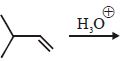
{C{H_3} - CH - CH - C{H_2}} \\
{\,\,\,\,\,\,\,\,\,\,\,\,|\,\,\,\,\,\,\,\,\,\,\,\,\,\,\,\,|\,\,\,\,\,\,\,\,\,\,\,\,\,\,\,\,|\,\,} \\
{\,\,\,\,\,\,\,\,\,\,\,\,C{H_3}\,\,\,\,\,\,\,\,OH\,\,\,\,\,\,\,H\,\,}
\end{array}$ as a major product
- A
- B
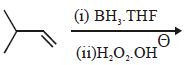
- ✓
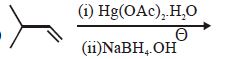
- D
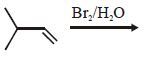


Generate a complete, print-ready paper with questions like this in minutes — across 16+ boards, with answer keys.

$(i)$ forms aldehydes on ozonolysis followed by the hydrolysis.
$(ii)$ when vaporized completely $1.53\, \mathrm{~g}$ of $\mathrm{A}$, gives $448\, \mathrm{~mL}$ of vapour at $STP.$
The number of carbon atoms in a molecule of compound $A$ is ...... .
Assertion $A :$- Carbon forms two important oxides $- CO$ and $CO _2 . CO$ is neutral whereas $CO _2$ is acidic in nature.
Reason $R :$- $CO _2$ can combine with water in a limited way to form carbonic acid, while $CO$ is sparingly soluble in water.
In the light of the above statements, choose the most appropriate answer from the options given below :-
Step $I\,\,:$ ${H_2}O(g)\, \to \,H(g)\, + \,OH(g)\,;$ $\Delta H = 498\,kJ\,mol^{-1}$
Step $II\,\,:$ $OH(g)\, \to \,H(g)\, + \,O(g)\,;$ $\Delta H = 428\,kJ\,mol^{-1}$
The bond enthalpy of the $O-H$ bond is....$kJ\,mol^{-1}$