MCQ
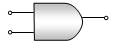
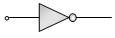
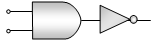
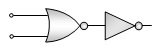
Which represents $\text{NAND}$ gate
  • B
  • C
  • D

Answer

Correct option: A.

Need a full question paper?

Generate a complete, print-ready paper with questions like this in minutes — across 16+ boards, with answer keys.
Start Generating Free

Similar questions

A long straight wire carries a current of $\pi\ \text{amp.}$ The magnetic field due to it will be $5 \times 10^{-5}\ \ce{Weber/m^2}$  at what distance from the wire $[\mu_0=$ permeability of air$]$
A dip circle is so set that its needle moves freely in the magnetic meridian. In this position, the angle of dip is 40º. Now the dip circle is rotated so that the plane in which the needle moves makes an angle of 30º with the magnetic meridian. In this position, the needle will dip by an angle:
A 25 watt, 220 volt bulb and a 100 watt, 220 volt bulb are connected in series across a 220 volt lines. Which electric bulb will glow more brightly(a) 25 watt bulb(b) 100 watt bulb(c) First 25 watt and then 100 watt(d) Both with same brightness
   
   
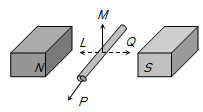
An electric potential difference will be induced between the ends of the conductor shown in the diagram, when the conductor moves in the direction
A watch glass containing some powdered substance is placed between the pole pieces of a magnet. Deep concavity is observed at the centre. The substance in the watch glass is:
The transfer ratio of a transistor is 50. The input resistance of the transistor when used in the common-emitter configuration is 1 KW. The peak value for an A.C input voltage of 0.01 V peak is(a) 100 mA(b) 0.01 mA(c) 0.25 mA(d) 500 mA
       
Two circular loops of equal radii are placed coaxially at some separation. The first is cut and a battery is inserted in between to drive a current in it. The current c~anges slightly because of the variation in resistance with temperature. During this period, the two loops:
The average kinetic energy of the thermal neutrons is of the order of $($Boltzmann's constant $\mathrm{K}_{\mathrm{B}}=8 \times 10^{-5} \mathrm{eV} /$ Kelvin $)$ 
$M_n$ and $M_p$ represent mass of neutron and proton respectively. If an element having atomic mass $M$ has $N-$neutron and $Z-$proton, then the correct relation will be
An electron $($mass $= 9.1 \times 10^{-19} \mathrm{~kg} ;$ charge $=1.6 \times 10^{-19} C)$ experiences no deflection if subjected to an electric field of $3.2 \times 10^5 \mathrm{V} / \mathrm{m},$ and a magnetic fields of $2.0 \times 10^{-3}\ \mathrm{Wb} / \mathrm{m}^2.$ Both the fields are normal to the path of electron and to each other. If the electric field is removed, then the electron will revolve in an orbit of radius