Question
Which resistor is difficult to make of having a value less than about 2 Ohms?

Answer

  1. Carbon Resistor
Explanation:
Carbon resistor is difficult to make of having a value less than about 20 Ohms because they have ability to withstand high energy pulses, when current flow through the carbon composition body conducts the energy. So carbon resistor can be made with a higher resistance.

Need a full question paper?

Generate a complete, print-ready paper with questions like this in minutes — across 16+ boards, with answer keys.
Start Generating Free

Similar questions

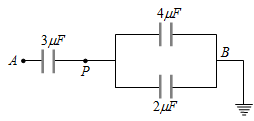
In the figure a potential of $+ 1200\ V$ is given to point $A$ and point $B$ is earthed, what is the potential at the point $P$
A constant current i is maintained in a solenoid. Which of the following quantities will increase if an iron rod is inserted in the soleniod along axis?
  1. Magnetic field at the centre.
  2. Mangetic flux linked with the solenoid.
  3. Self-inductance of the solenoid.
  4. Rate of Joule heating.
A person using a lens as a simple microscope sees an:
Assertion :   Magnetic flux can produce induced e.m.f.
Reason     : Faraday established induced e.m.f. experimentally.(a) If both assertion and reason are true and the reason is the correct explanation of the assertion.(b) If both assertion and reason are true but reason is not the correct explanation of the assertion.(c) If assertion is true but reason is false.(d) If assertion is false but reason is true.


A symmetric double convex lens is cut in two equal parts by a plane containing the principal axis. If the power of the original lens was $4D,$ the power of a divided lens will be$:$
The electrostatic energy of the system made by two electric dipoles kept at a distance 'r' is proportional to :
An electric dipole consisting of charges +q and -q separated by a distance L is in stable equilibrium in a uniform electric field $\vec{\text{E}}.$ The electrostatic potential energy of the dipole is:
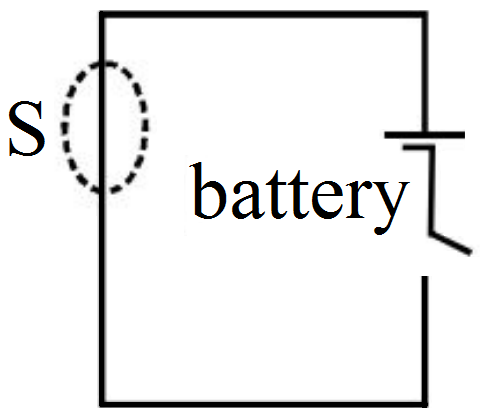
A closed surface S is constructed around a conducting wire connected to a battery and a switch (figure). As the switch is closed, the free electrons in the wire start moving along the wire. In any time interval, the number of electrons entering the closed surface S is equal to the number of electrons leaving it. On closing the switch, the flux of the electric field through the closed surface:
A radioactive sample has $N_0$ active atoms at $t = 0.$ If the rate of disintegration at any time is $R$ and the number of atoms is $N,$ then the ratio $R/N$ varies with time as
According to Faraday's law of electromagnetic induction(a) The direction of induced current is such that it opposes the cause producing it(b) The magnitude of induced e.m.f. produced in a coil is directly proportional to the rate of change of magnetic flux(c) The direction of induced e.m.f. is such that it opposes the cause producing it(d) None of the above