Question
Which rules are followed in nuclear reactions?

Answer

The following rules are followed in nuclear reactions :
(i) Charge is conserved.
(ii) Linear and angular momentum are conserved.
(iii) The sum of mass and energy remains conserved.
(iv) Nucleon is conserved.

Need a full question paper?

Generate a complete, print-ready paper with questions like this in minutes — across 16+ boards, with answer keys.
Start Generating Free

Similar questions

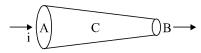
In the given figure, a current carrying conductor of non-uniform cross-section is shown. At what points, the magnitude will be maximum of (i) current (ii) current density and (iii) drift velocity?
Image
Why are cells combined ? Also, how can the combination of cells be done?
The pendulum of a clock is replaced by a spring-mass system with the spring having spring constant 0.1N/m. What mass should be attached to the spring?
A gas of hydrogen-like ions is prepared in a particular excited state A. It emits photons having wavelength equal to the wavelength of the first line of the Lyman series together with photons of five other wavelengths. Identify the gas and find the principal quantum number of the state A.
The angles of dip at two places located on the earth are 0° and 90° respectively. Where are the places located?
A metallic rod of 'L' length is rotated with angular frequency of '$\omega$' with one end hinged at the centre and the other end at the circumference of a circular metallic ring of radius L, about an axis passing through the centre and perpendicular to the plane of the ring. A constant and uniform magnetic field B parallel to the axis is present everywhere. Deduce the expression for the emf between the centre and the metallic ring.
A beam of electrons enters crossed region of electric field of intensity $E$ and magnetic field of intensity B. For what speed of electrons, the electron beam will remain unaffected?
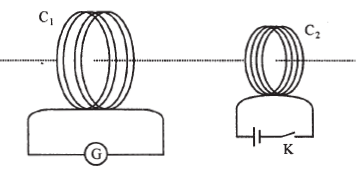
A current is induced in coil C1 due to the motion of current carrying coil C2. (a) Write any two ways by which a large deflection can be obtained in the galvanometer G. (b) Suggest an alternative device to demonstrate the induced current in place of a galvanometer.

State the types of electric charge. Who coined these names?
The magnetic field in a plane electromagnetic wave is given by $B_y=\left(2 \times 10^{-7}\right) T \sin \left(0.5 \times 10^3 x+1.5 \times 10^{11} t\right)$.
(a) What is the wavelength and frequency of the wave?
(b) Write an expression for the electric field.