Question
Which rules are followed in nuclear reactions?

Answer

The following rules are followed in nuclear reactions :
(i) Charge is conserved.
(ii) Linear and angular momentum are conserved.
(iii) The sum of mass and energy remains conserved.
(iv) Nucleon is conserved.

Need a full question paper?

Generate a complete, print-ready paper with questions like this in minutes — across 16+ boards, with answer keys.
Start Generating Free

Similar questions

An $\alpha$-particle after passing through a potential difference of $2 \times 10^6 V$ falls on a silver foil. The atomic number of silver is 47 . Calculate (i) the kinetic energy of the $\alpha$-particle at the time of falling on the foil (ii) the kinetic energy of the $\alpha$-particle at a distance of $5 \times 10^{-14} m$ from the nucleus and (iii) the shortest distance from the nucleus of silver to which the $\alpha$-particle reaches.
In double-slit experiment using light of wavelength 600 nm, the angular width of a fringe formed on a distant screen is 0.1º. What is the spacing between the two slits?
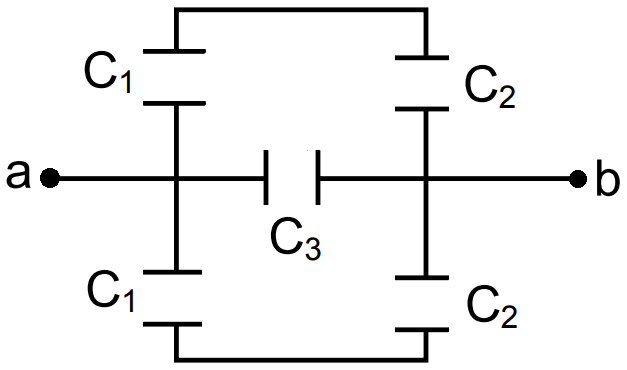
Find the equivalent capacitance of the syatem shown in figure between the points a and b.

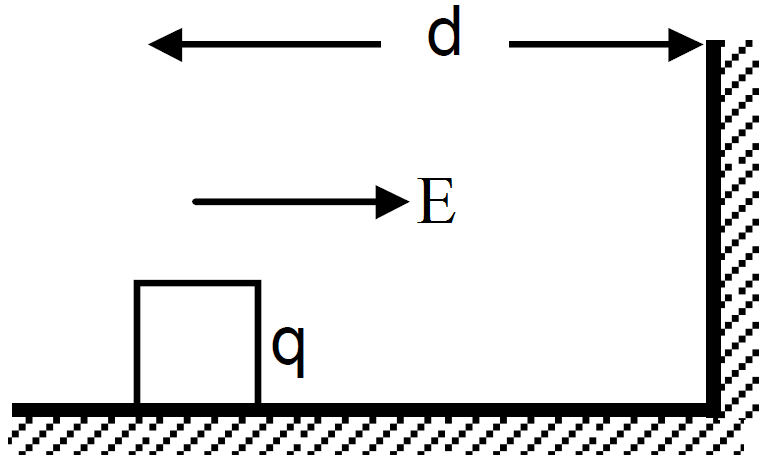
A block of mass m containing a net positive charge q is placed on a smooth horizontal table which terminates in a vertical wall as shown in figure. The distance of the block from the wall is d. A horizontal electric field E towards right is switched on. Assuming elastic collisions (if any) find the time period of the resulting oscillatory motion. Is it a simple harmonic motion?

The distance between the two plates of a parallel plate capacitor is 4 mm . A 3 mm thick dielectric strip having dielectric constant 3 is placed between the plates parallel to the plates. The distance between the plates is arranged in such a way that the capacitance of the capacitor becomes $2 / 3$ of the initial capacitance. What is the new distance between the plates?
Consider two particles A and B having equal charges and placed at some distance. The particle A is slightly displaced towards B. Does the force on B increase as soon as the particle A is displaced? Does the force on the particle A increase as soon as it is displaced?
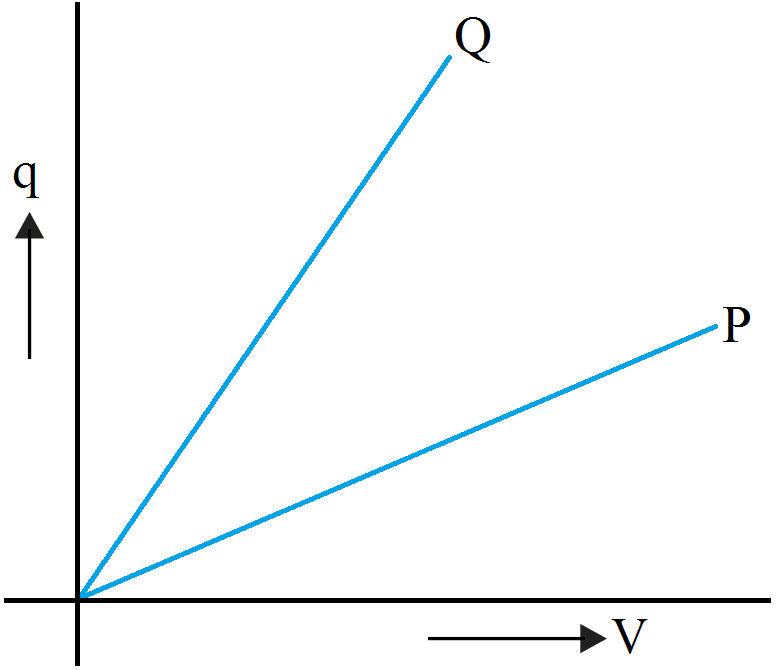
The given graph shows the variation of charge q versus potential difference V for two capacitors C1 and C2. The two capacitors have same plate separation but the plate area of C2 is double than that of C1. Which of the two graphs P and Q correspond to capacitors C1 and C2 and why?

Explain (or write a short note on) capacitors and capacitance.
Write formula for Bohr's frequency.
The mass of a H-atom is less than the sum of the masses of a proton and electron. Why is this?