Question
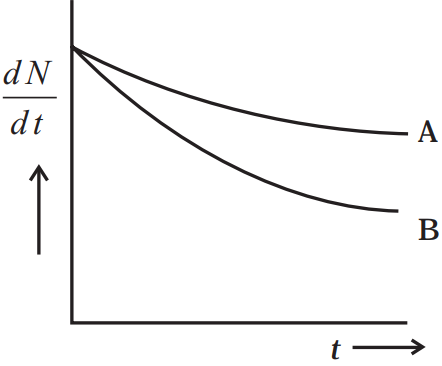
Which sample, A or B shown in Fig. has shorter mean-life?

Answer

B has shorter mean life as $\lambda$ is greater for B. This can be explained mathematically as given below
From the given graph, at $\text{t}=0,\Big(\frac{\text{dN}}{\text{dt}}\Big)_\text{A}=\Big(\frac{\text{dN}}{\text{dt}}\Big)_\text{B}\Rightarrow\ (\text{N}_0)_\text{A}=(\text{N}_0)_\text{B}$
Considering any instant t by drawing a line perpendicular to time axis, we find that $\Big(\frac{\text{dN}}{\text{dt}}\Big)_\text{A}>\Big(\frac{\text{dN}}{\text{dt}}\Big)_\text{B}$
$\Rightarrow\ \lambda_\text{A}\text{N}_\text{A}>\lambda_\text{B}\text{N}_\text{B}$
$\because\ \text{N}_\text{A}>\text{N}_\text{B}$ (rate of decay of B is slower)
$\because\ \lambda_\text{B}>\lambda_\text{A}$
As, average life, $\tau=\frac{1}{\lambda}$
$\Rightarrow\ \tau_\text{A}>\tau_\text{B}$

Need a full question paper?

Generate a complete, print-ready paper with questions like this in minutes — across 16+ boards, with answer keys.
Start Generating Free

Similar questions

Draw a schematic ray diagram of reflecting telescope showing how rays coming from a distant object are received at the eye-piece. Write its two important advantages over a refracting telescope.
If this telescope is used to view a 100 m tall tower 3 km away, what is the height of the image of the tower formed by the objective lens?
A rod of length L is placed along the X-axis between x = 0 and x = L. The linear density (mass/ length) $\rho$ of the rod varies with the distance x from the origin as $\rho=\text{a + bx.}$
  1. Find the SI units of a and b.
  2. Find the mass of the rod in terms of a, b and L.
Figure shows a rough track, a portion of which is in the form of a cylinder of radius R. With what minimum linear speed should a sphere of radius r be set rolling on the horizontal part so that it completely goes round the circle on the cylindrical part.
A metre scale made of steel is calibrated at 20°C to give correct reading. Find the distance between the 50cm mark and the 51cm mark if the scale is used at 10°C. Coefficient of linear expansion of steel is $1.1 \times 10^{-5} $$ ^\circ C^{-1}.$
A charged particle having a charge of $-2.0 \times 10^{-6}C$ is placed close to a nonconducting plate having a surface charge density $4.0 \times 10^{-5}Cm^{-2}$. Find the force of attraction between the particle and the plate.
A glass full of water has a bottom of area $ 20cm^2,$ top of area $20cm^2$, height 20cm and volume half a litre.
  1. Find the force exerted by the water on the bottom.
  2. Considering the equilibrium of the water, find the.
Resultant force exerted by the sides of the glass on the water. Atmospheric pressure $= 1.0 \times 10^5N/m^2$. Density of water $= 1000kg/m^3$ and $g = 10m/s^2$. Take all numbers to be exact.
A long cylindrical wire of radius b carries a current i distributed uniformly over its cross-section. Find the magnitude of the magnetic field at a point inside the wire at a distance a from the axis.
Two electric charges $+Q$ and $-Q(x-y)$ are placed at the points $\left(-x_2, 0\right)$ and $\left(x_1, 0\right)$ respectively in the plane. Find the magnitude and direction of the resultant electric field at the origin $(0,0)$.
A block A can slide on a frictionless incline of angle $\theta$ and length l, kept inside an elevator going up with uniform velocity v. Find the time taken by the block to slide down the length of the incline if it is released from the top of the incline.