MCQ
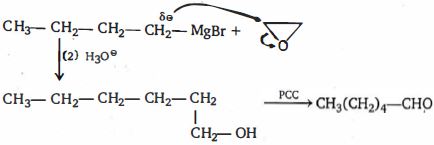
Which sequence represents the best synthesis of hexanal ?

$\underset{Hexanal}{\mathop{C{{H}_{3\text{ }}}C{{H}_{2}}C{{H}_{2}}C{{H}_{2}}C{{H}_{2}}CH=O}}\,$

  • A
    $1$. $CH_3 CH_2CH_2 CH_2 Br + NaC =CH$

    $2$. $H_2O,H_2SO_4,HgSO_4$

  • B
    $\begin{matrix}
       \,\,\,\,\,\,\,\,\,\,\,\,\,\,\,\,\,\,\,\,\,\,\,\,\,\,\,\,\,\,\,\,\,\,\,\,\,\,\,\,\,\,\,\,\,\,\,\,\,\,\,\,\,\,\,\,\,\,\,\,\,\,\,\,\,\,\,\,\,\,\,\,\,\,\,\,O  \\
       \,\,\,\,\,\,\,\,\,\,\,\,\,\,\,\,\,\,\,\,\,\,\,\,\,\,\,\,\,\,\,\,\,\,\,\,\,\,\,\,\,\,\,\,\,\,\,\,\,\,\,\,\,\,\,\,\,\,\,\,\,\,\,\,\,\,\,\,\,\,\,\,\,\,\,\,||  \\
       1.\,\,C{{H}_{3\text{ }}}C{{H}_{2}}C{{H}_{2}}CH=C{{H}_{2}}+C{{H}_{3}}\,C\,OH  \\
    \end{matrix}$

    $2$. $CH_3 MgBr,$ diethyl ether

    $3$. $H_3O^+$

    $4$. $PCC, CH_2Cl_2$

  • C
    $\begin{matrix}
       \,\,\,\,\,\,\,\,\,\,\,\,\,\,\,\,\,\,\,\,\,\,\,\,\,\,\,\,\,\,\,\,\,\,\,\,\,\,\,\,\,\,\,\,\,O  \\
       \,\,\,\,\,\,\,\,\,\,\,\,\,\,\,\,\,\,\,\,\,\,\,\,\,\,\,\,\,\,\,\,\,\,\,\,\,\,\,\,\,\,\,\,||  \\
       1.\,\,C{{H}_{3\text{ }}}C{{H}_{2}}C{{H}_{2}}C{{H}_{2}}\,C\,C{{H}_{3}}  \\
    \end{matrix}$

    $\begin{matrix}
       \,\,\,\,\,O  \\
       \,\,\,\,\,||  \\
       2.\,\,\,C{{H}_{3}}\,C\,OH  \\
    \end{matrix}$

    $3.\, LiAlH_4$

    $4.\, H_2O$

    $5.\, PCC, CH_2Cl_2$

  • $2.\, H_3O^{\oplus}$

    $3. \, PCC,CH_2Cl_2$

Answer

Correct option: D.
$2.\, H_3O^{\oplus}$

$3. \, PCC,CH_2Cl_2$
d

Need a full question paper?

Generate a complete, print-ready paper with questions like this in minutes — across 16+ boards, with answer keys.

Start Generating Free

Similar questions

In Bohr’s model, if the atomic radius of the first orbit is ${r_0}$, then the radius of the fourth orbit is
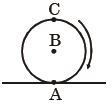
A sphere is rolling without slipping on a fixed horizontal plane surface. In the figure $A$ is the point of contact, $B$ is the centre of sphere and $C$ is its topmost point, then

$(i){\vec V_C} - {\vec V_A} = 2\left( {{{\vec V}_B} - {{\vec V}_C}} \right)$

$(ii){\vec V_C} - {\vec V_B} = {\vec V_B} - {\vec V_A}$

$(iii)\left| {{{\vec V}_C} - {{\vec V}_A}} \right| = 2\left| {{{\vec V}_B} - {{\vec V}_C}} \right|$

$(iv)\left| {{{\vec V}_C} - {{\vec V}_A}} \right| = 4\left| {{{\vec V}_B}} \right|$

In an $n-p-n$ common emitter ($CE$) transistor the collector current changes from $5\,mA$ to $16\,mA$ for the change in base current from $100\,\mu A$ and $200\,\mu A$, respectively. The current gain of transistor is
$Pascal-Second$ has dimension of
Two identical spheres each of mass $2 \mathrm{~kg}$ and radius $50 \mathrm{~cm}$ are fixed at the ends of a light rod so that the separation between the centers is $150 \mathrm{~cm}$. Then, moment of inertia of the system about an axis perpendicular to the rod and passing through its middle point is $\frac{x}{20} \mathrm{~kg} \mathrm{~m}^2$, where the value of $\mathrm{x}$ is____.
A man projects a coin upwards from the gate of a uniformly moving train. The path of coin for the man will be
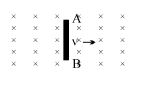
Arod $AB$ moves with a uniform velocity $v$ in a uniform magnetic field as shown in figure.
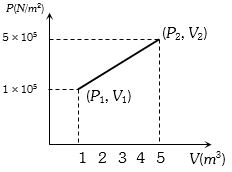
A system changes from the state $({P_1},\;{V_1})$ to $({P_2},{V_2})$ as shown in the figure. What is the work done by the system
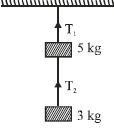
Two masses of $5\, kg$ and $3\, kg$ are suspended with the help of massless inextensible strings as shown in figure. The whole system is going upwards with an acceleration of $2\, ms^{-2}$. The tensions $T_1$ and $T_2$ are respectively (Take $g = 10\, ms^{-2}$)
An electric dipole is placed on the $x-$axis as shown in the figure. Consider a spherical closed surface around it. Then