MCQ
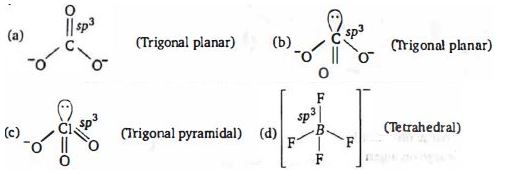
Which species is planar?
  • $CO^{2-}_3$
  • B
    $SO^{2-}_3$
  • C
    $ClO^-_3$
  • D
    $BF^-_4$

Answer

Correct option: A.
$CO^{2-}_3$
a

Need a full question paper?

Generate a complete, print-ready paper with questions like this in minutes — across 16+ boards, with answer keys.

Start Generating Free

Similar questions

$2\, gm$ acetic acid and $3\, gm$ sodium acetate are present in $100\, ml$. aqueous solution then what will be the $pH$ of solution if ionisation constant of acetic acid is $1.8 \times 10^{-5}$
The value of osmotic pressure of a $ 0.2\,M$  aqueous solution at $293\,K$  is ........... $atm$
Which of the following compound has the smallest bond angle $(X - A - X)$ in  each series respectively?
$(A)\, OSF_2$              $OSCl_2$            $OSBr_2$
$(B)\, SbCl_3$              $SbBr_3$             $SbI_3$
$(C)\, PI_3$                  $AsI_3$                $SbI_3$
Given below are two statements: one is labelled as Assertion $(A)$ and the other is labelled as Reason $(R)$

Assertion $(A) :$ At $10^{\circ} C$, the density of a $5\, M$ solution of $KCl$ [atomic masses of $K$ and $Cl$ are $39$ and $35.5\, g \,mol ^{-1}$ ]. The solution is cooled to $-21^{\circ} C$. The molality of the solution will remain unchanged.

Reason $(R):$ The molality of a solution does not change with temperature as mass remains unaffected with temperature.

In the light of the above statements, choose the correct answer from the options given below
The extent of ionization increases
The dipole moment of $HBr$ is $1.6 \times {10^{ - 30}}\,cm$ and interatomic spacing is $1\,\mathop A\limits^o $. The $\%$ ionic character of $HBr$ is
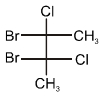
The total number$(s)$ of stable conformers with non-zero dipole moment for the following compound is (are)
The wavelength of a spectral line for an electronic transition is inversely related to
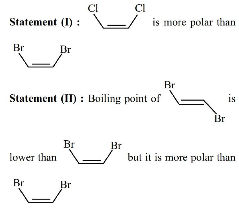
Given below are two statements :
Image
In the light of the above statements, choose the most appropriate answer from the options given below :
If the surface area of the reactants increases, then order of the reaction