MCQ
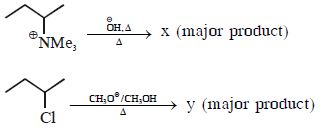
Which statement is correct ?
  • A
    Both $x$ and $y$ are $2$ -Butene
  • B
    Both $x$ and $y$ are $1-$ Butene
  • $x$ is $1-$ Butene and $y$ is $2 -$ Butene
  • D
    $x$ is $2 -$ Butene and $y$ is $1-$ Butene
Answer

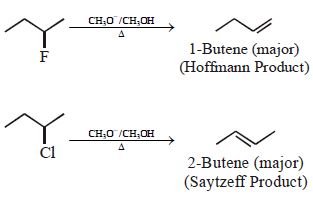
Correct option: C.
$x$ is $1-$ Butene and $y$ is $2 -$ Butene
c

Need a full question paper?

Generate a complete, print-ready paper with questions like this in minutes — across 16+ boards, with answer keys.

Start Generating Free

Similar questions

In the isolation of fluorine, a number of difficulties were encountered. Which statement is correct
A sample of calcium carbonate $(CaC{O_3})$ has the following percentage composition : $Ca = 40\%$; $C = 12\%$; $O = 48\%$ If the law of constant proportions is true, then the weight of calcium in $4 \,g$ of a sample of calcium carbonate obtained from another source will be.....$g$
The rate of radioactive disintegration at an instant for a radioactive sample of half life $2.2 \times 10^{9}\; \mathrm{s}$ is $10^{10} \;\mathrm{s}^{-1} .$ The number of radioactive atoms in that sample at that instant is
Soft heavy metal melts at ${30\,^o}C$ and is used in making heat sensitive thermometers the metal is
$n-$ hexane $\xrightarrow{{catalyst}}$ benzene

catalyst is

Conductivity of $0.001\  M$ aq.solution of $Na_2SO_4$ is found to be $2.6 × 10^{-3}\  S\, cm^{-1}$ at $25\,^oC$. If limiting molar conductance of $Na^+$ is $50\  S\, cm^2 \,mol^{-1}$, then limiting molar conductance of $SO_4^{2-}$ will be .............. ${\rm{S}}\,{\rm{c}}{{\rm{m}}^2}{\rm{mo}}{{\rm{l}}^{ - 1}}$ (neglect conductivity of water).
Which one is a mixed salt
The energy of an electron in the first Bohr orbit of hydrogen atom is $-2.18 \times 10^{-18}\,J$. Its energy in the third Bohr orbit is $........$.
Conc. $H_2SO_4$ cannot be used to prepare $HBr$ from $NaBr$ because it :
In the reaction product $D$ is $\begin{array}{*{20}{c}}
  {C{H_2}} \\ 
  {||\,\,\,\,\,\,\,\,} \\ 
  {C{H_2}} 
\end{array}$ $\xrightarrow{{B{r_2}/CC{l_4}}}A\xrightarrow{{KCN}}B\xrightarrow{{{H_3}{O^ + }}}C\xrightarrow{\Delta }D$