MCQ
Which statement is true with respect to a catalyst?
  • Does not alter Gibbs energy
  • B
    It increases equillibrium constant
  • C
    It increases value of activation energy
  • D
    It increases potential energy barrier

Answer

Correct option: A.
Does not alter Gibbs energy
A

Need a full question paper?

Generate a complete, print-ready paper with questions like this in minutes — across 16+ boards, with answer keys.

Start Generating Free

Similar questions

Which of the following products is formed when benzaldehyde is treated with $CH_3MgBr$ and the addition product so obtained is subjected to acid hydrolysis ?
Which of the following statements is right
The reaction ${N_2}{O_5}$ (in $CCl_4$ solution) $ \to 2N{O_2}$ (solution) $ + \frac{1}{2}{O_2}(g)$ is of first order in ${N_2}{O_5}$ with rate constant $6.2 \times {10^{ - 1}}{s^{ - 1}}.$ What is the value of rate of reaction when $[{N_2}{O_5}] = 1.25\,mole\,{l^{ - 1}}$
$C_6H_6+\,C{{H}_{3}}C{{H}_{2}}C{{H}_{2}}Cl\,+\,AlC{{l}_{3}}\,\to $ $X$ (Major product)

$X$ (Major product) $\xrightarrow{HN{{O}_{3}}+{{H}_{2}}S{{O}_{4}}}Y$ (Major product)  $\xrightarrow{Sn\,\,+\,\,HCl}\,Z\,\xrightarrow[S{{O}_{3}}]{}W$

$W$ is 

Which of the following chloride does not react with $PCl_5$ on heating?
Match each of the compounds in Column $I$ with its characteristic reaction$(s)$ in Column $II$.
Column $I$ Column $II$
$(A)$ $\mathrm{CH}_3 \mathrm{CH}_2 \mathrm{CH}_2 \mathrm{CN}$ $(p)$ Reduction with $\mathrm{Pd}-\mathrm{C} / \mathrm{H}_2$
$(B)$ $\mathrm{CH}_3 \mathrm{CH}_2 \mathrm{OCOCH}_3$ $(q)$ Reduction with $\mathrm{SnCl}_2 / \mathrm{HCl}$
$(C)$ $\mathrm{CH}_3-\mathrm{CH}=\mathrm{CH}-\mathrm{CH}_2 \mathrm{OH}$ $(r)$ Development of foul smell on treatment with chloroform and alcoholic $\mathrm{KOH}$
$(D)$ $\mathrm{CH}_3 \mathrm{CH}_2 \mathrm{CH}_2 \mathrm{CH}_2 \mathrm{NH}_2$ $(s)$ Reduction with diisobutylaluminium hydride $(DIBAL-H)$
  $(t)$ Alkaline hydrolysis
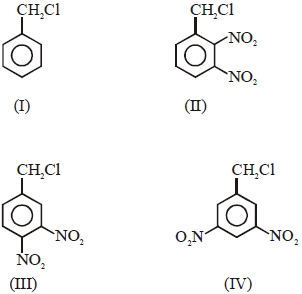
The decreasing order of reactivity of the following compounds towards nucleophilic substitution $\left( S _{ N }{ }^{2}\right)$ is :
The relation between faraday constant $F$, electron charge $e$ and avogadro number $N$ is
Consider the following reaction 

Which response contains all the correct statement about this process ?

$(1)$ Dehydration                              $(2)\, E_2$ mechanism        
$(3)$ Carbon skeleton migration        $(4)$ Most stable alkene will form
$(5)$ Single-step reaction

The reaction is called $\begin{array}{*{20}{c}}
  {2C{H_3} - C - O{C_2}{H_5}} \\ 
  {||\,\,\,} \\ 
  {O\,\,\,} 
\end{array}$ ${\xrightarrow{{{C_2}{H_5}ONa}}}$  $\begin{array}{*{20}{c}}
  {C{H_3} - C - C{H_2} - C - O{C_2}{H_5}} \\ 
  {||\,\,\,\,\,\,\,\,\,\,\,\,\,\,\,\,\,\,\,\,\,\,\,\,\,\,\,||\,\,\,\,\,\,\,} \\ 
  {O\,\,\,\,\,\,\,\,\,\,\,\,\,\,\,\,\,\,\,\,\,\,\,\,\,\,O\,\,\,\,\,} 
\end{array}$ $ + \,{C_2}{H_5}OH$