MCQ
Which term describes the mass of 6.022 × 10²³ representative particles?
  • A
    Molar mass.
  • B
    Avogadro's number.
  • C
    Empirical formula.
  • D
    Molecular formula.

Answer

  1. Molar mass.

Explanation:

Molar mass of a compound describes the total mass of 6.023 × 10²³ atoms or particles of the compound.

Ex: Molar mass of H2​ = 2g

Need a full question paper?

Generate a complete, print-ready paper with questions like this in minutes — across 16+ boards, with answer keys.

Start Generating Free

Similar questions

Given below are two statements: one is labelled as Assertion $(A)$ and the other is labelled as Reason $(R)$

Assertion $(A)$ : Boron is unable to form $BF _{6}^{3-}$

Reason $(R)$ : Size of $B$ is very small.

In the light of the above statements, choose the correct answer from the options given below.

If shortest wavelength of $He^+$ ion in Balmer series is $X\,metres$ then longest wavelength in Paschen series of $Li^{+2}$ ion is
Addition of $HCl$ to $3, 3$ -dimethyl- $1$ -butene yields two products, one of  which has a rearranged carbon skeleton. Among the following carbocations,  select the possible intermediates in that  reaction ?

$\mathop {{{(C{H_3})}_3}C\mathop C\limits^ +  HC{H_2}Cl}\limits_1 $         $\mathop {{{(C{H_3})}_3}C\mathop C\limits^ +  HC{H_3}}\limits_2 $             $\mathop {\begin{array}{*{20}{c}}
  {{{(C{H_3})}_2}C\mathop C\limits^ +  {{(C{H_3})}_2}} \\ 
  {|\,\,\,\,} \\ 
  {Cl\,\,\,} 
\end{array}}\limits_3 $              $\mathop {{{(C{H_3})}_2}\mathop C\limits^ +  CH{{(C{H_3})}_2}}\limits_4 $
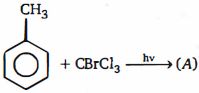
(no ring substitution) Product $(A)$ is
Compound $X$ of molecular formula $C_4H_6$ takes up one equivalent of hydrogen in presence of $Pt$ to form another compound $Y$ which on ozonolysis gives only ethanoic acid. The compound $X$ can be
Among $\mathrm{H}_2, \mathrm{He}_2^{+}, \mathrm{Li}_2, \mathrm{Be}_2, \mathrm{~B}_2, \mathrm{C}_2, \mathrm{~N}_2, \mathrm{O}_2^{-}$, and $\mathrm{F}_2$, the number of diamagnetic species is (Atomic numbers: $\mathrm{H}=1, \mathrm{He}=2, \mathrm{Li}=3, \mathrm{Be}=4, \mathrm{~B}=5, \mathrm{C}=6, \mathrm{~N}=7, \mathrm{O}=8, \mathrm{~F}=9$ )
$\begin{array}{*{20}{c}}
  {2C{H_3} - C = C{H_2}} \\ 
  {\,|} \\ 
  {\,\,\,Ph} 
\end{array}\xrightarrow{{H - A\,(acid)}}\mathop {(A)}\limits_{(major)} $

Product $(A)$ is

The above reaction completes with the mechanism
Elements those are exception of $n + l$ rule
How many alkene on catalytic hydrogenation given isopentane as a product ?